Inside Libya’s Food Security Crisis: Why a Nation of Oil Still Struggles to Eat
Libya, blessed with oil but short on arable land and political coherence, can feed only a fraction of its population. Barely a tenth of the country’s food is grown domestically, leaving Libyans exposed to every spike in global commodity prices and every disruption in local supply chains. When violence or currency swings shake the country – as they often do – bread and vegetables become not just more expensive, but symbols of Libya’s wider fragility.
Agricultural shortcomings in the country long predate its post-2011 turmoil. Even during the Gaddafi era, farming occupied a cultural space larger than its economic weight: fewer than a quarter of households tended fields, and agriculture contributed only a sliver of GDP. Since then, the sector has been squeezed further by insecurity, soaring input costs, and disinvestment. Farmers have abandoned land they can no longer afford to cultivate, state-run farms have withered without steady budgets, and the seasonal foreign labor on which many growers relied has vanished. By 2025, officials openly acknowledge what consumers already know – that local harvests barely dent national demand.
Environmental constraints compound the problem. Libya receives only around 56 millimeters of rain annually, placing it among the world’s most water-stressed countries. Agriculture depends heavily on water pumped from ancient aquifers via the Great Man-Made River, an energy-intensive lifeline vulnerable to both overuse and conflict. The 2023 dam collapses in eastern Libya, triggered by torrential rains, were a sobering reminder of this fragility. Entire districts were inundated, farmland was washed away, and tens of thousands were displaced. In Libya’s parched landscape, a single storm or drought can ripple across food production for seasons.
But while environmental limits set the ceiling for domestic farming, Libya’s fractured political and economic landscape determines how food actually moves – from ports to warehouses, from wholesalers to bakeries. With rival authorities governing different regions and a constellation of militias controlling key checkpoints, logistics are unpredictable at best and extortionate at worst. Trucks carrying wheat, sugar, or oil have been halted at makeshift roadblocks, adding unofficial “fees” that consumers ultimately pay. Periodic clashes around Tripoli or Benghazi often delay shipments, and in remote southern towns, residents routinely pay double or triple the prices seen along the coast. Geography should not dictate who can afford bread, but in Libya it often does.
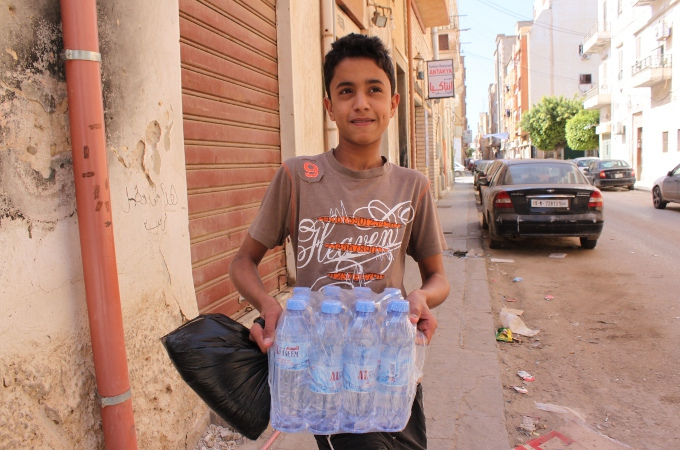
These market distortions feed directly into inflation. When the dinar weakens or trade routes close, food prices rise quickly, and households – especially those dependent on public salaries – feel the shock almost immediately. Aid groups report families increasingly narrowing their diets to bread and tea, cutting meat and produce except on special occasions. Official inflation statistics sometimes suggest modest increases, but these figures are softened by government subsidies that mask rising underlying costs. Political leaders have long hesitated to reform these subsidies, wary of public backlash. Yet the system’s hidden inefficiencies – smuggling, credit delays for importers, and opaque distribution chains – leave Libya more vulnerable, not less.
Despite Libya’s food sector seeming trapped between natural limitations and political dysfunction, reform is not futile. What it does mean is that progress hinges on reducing dependency and strengthening the connective tissue between regions. A resilient food economy is not achieved by doubling down on self-sufficiency – an unrealistic aspiration in Libya’s climate – but by making smarter use of scarce resources and ensuring that imports flow smoothly and transparently.
Part of that effort must focus on farming, but with a targeted scope. Improving irrigation technology, rehabilitating degraded wells, and promoting drought-resistant crops can raise output without straining the aquifers that underpin the entire system. Small farmers need access to affordable inputs and credit, particularly as the state’s ability to supply subsidized fuel and fertilizers becomes less reliable. Donor-funded water and land rehabilitation programs, if designed with local cooperatives, could improve yields modestly while protecting the environment.
Yet the larger gains lie in repairing the market infrastructure that moves food across Libya’s fragmented map. A unified system for tracking national grain reserves, coordinating imports, and monitoring prices across regions could help stabilize the market and curb opportunities for profiteering. Strengthening storage facilities, upgrading transport corridors, and reducing militia interference would cut spoilage and keep prices more consistent between the coast and the south. Crucially, any subsidy reform must channel benefits to households and farmers directly, through targeted transfers or subsidized credit, rather than funneling cheap goods into a system easily manipulated by smuggling networks.
These reforms depend on political alignment, but they do not require a full national settlement to begin. Technical cooperation already occurs quietly across institutional lines – between water engineers, customs officials, and municipal administrators. Expanding such cooperation around food security could be an early confidence-building measure in a political landscape otherwise defined by mistrust.
Libya’s food crisis is often framed as a humanitarian concern, but its deeper importance is economic: no country can chart a stable future if its access to food depends entirely on global markets and the whims of domestic armed groups. Reducing this vulnerability is as fundamental to Libya’s recovery as rebuilding its oil sector or reforming its banking system. A state that can manage its food supply – efficiently, transparently, and across regional divides – lays the groundwork for broader economic stabilization. In a country where unity is elusive, a functioning food system might be one of the few achievable steps toward a shared national future.