One dollar, one price? What the Central Bank’s FX shift could mean for Libya’s economy
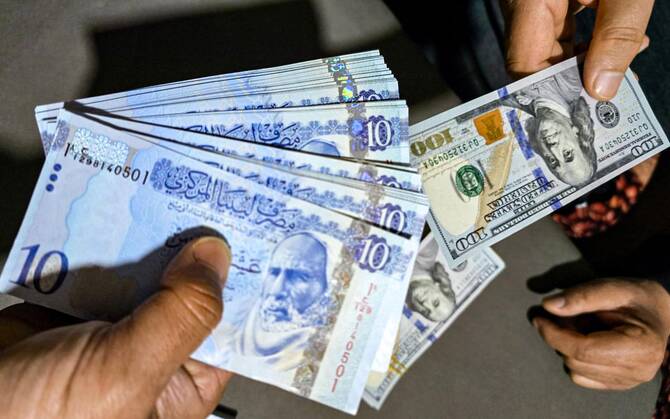
Libya’s Central Bank is reportedly preparing to cancel the commodity tax and apply a unified exchange rate of 6.37 dinars to the dollar across all uses, including personal transactions, imports, education, and medical expenses. On paper, the move looks like a technical adjustment. In practice, it could become one of the most meaningful changes to Libya’s economic framework in recent months.
That is because the issue goes well beyond tax policy. At stake is whether Libya can begin to simplify a foreign exchange system that has long operated through multiple prices, uneven access, and persistent uncertainty. In an economy as import dependent as Libya’s, the dollar is not just a financial instrument. It is a daily economic fact. It helps shape the price of food, medicine, tuition, consumer goods, and the cost structure facing nearly every trader and importer in the market.
This is what makes the Central Bank’s reported plan important. For years, Libya has lived with a fragmented currency reality. There has been the official rate, the effective rate citizens and businesses actually face through formal channels, and the price signaled by the parallel market. When one economy runs on several prices for the same dollar, confusion is inevitable. So are distortions. Businesses struggle to price accurately, consumers lose confidence in the formal system, and the gap between policy and lived economic reality grows wider.
The appeal of a unified exchange rate is therefore easy to understand. One clear rate would, in theory, make the system easier to navigate. Importers would be able to estimate costs more accurately. Families paying for treatment or studies abroad would face less confusion. Retailers and wholesalers would have a more stable benchmark for pricing goods. In a country where uncertainty often becomes an added cost in itself, clarity carries real value.
This point matters because Libya’s economy can absorb a difficult price more easily than a confusing one. Markets can adapt to a more expensive dollar when that price is transparent and consistently available. Businesses can revise margins, negotiate with suppliers, or pass on part of the cost over time. What is much harder to manage is a market where access to foreign currency is unpredictable and where official pricing does not always align with economic behavior on the ground. In such an environment, businesses do not merely price goods. They price risk, delay, and uncertainty.
Removing the commodity tax could help reduce some of that distortion. The tax has acted as an added burden on access to foreign currency, raising the effective cost of dollars even when the official rate appeared lower on paper. In that sense, scrapping it could make formal access more straightforward and potentially lower some of the hidden costs embedded in the import cycle. For an economy already facing inflationary pressure and strained household purchasing power, that would be a welcome step.
But the real test lies elsewhere. A unified exchange rate is only useful if the market believes it. That may sound obvious, yet it is the central issue. Exchange rate policy does not succeed because a new number is announced. Exchange rate succeeds when traders, households, and firms begin to treat that number as credible. In Libya, that means the official market must offer not only the right rate, but also reliable access, reasonable speed, and enough consistency to pull demand away from informal channels.
If that does not happen, the parallel market will continue to act as the economy’s shadow benchmark. Importers will still hedge against shortages. Consumers will still assume that official channels cannot fully meet demand. Businesses will continue to price goods with one eye on the banking system and another on the street. In that case, the reform may simplify the formal framework without changing the deeper logic of the market.
This is why credibility matters more than design. Libya’s foreign exchange problem has never been purely about arithmetic. It has also been about trust. When people lose confidence that dollars can be obtained smoothly through official channels, they stop treating the official rate as the real one. Once that happens, the state may still set a rate, but the market quietly chooses another. Closing that credibility gap requires more than a cleaner policy structure. It requires implementation that is broad, timely, and dependable.
There is also a larger macroeconomic context that should not be overlooked. Libya’s foreign exchange pressures reflect deeper structural imbalances, including dependence on oil revenues, high public spending, and recurring mismatches between the supply of foreign currency and demand for it. A unified rate may reduce distortion, but it cannot by itself solve those underlying pressures. It can make pricing more transparent. It cannot eliminate the broader vulnerabilities that keep the currency under strain.
Still, that should not diminish the potential importance of the move. Simplification has economic value of its own. So does transparency. For too long, Libya’s exchange rate system has asked households and firms to navigate too many layers of uncertainty. One dollar has not always carried one meaning. That has weakened planning, inflated risk, and given the informal market too large a role in shaping expectations.
Seen in that light, the Central Bank’s reported shift is not just a technical reform. It is an attempt to restore a basic principle to economic life: that a currency should have a clear and trusted price. Whether this effort succeeds will depend not on the announcement alone, but on what follows it. If official foreign currency access becomes smoother and more credible, the move could help narrow distortions and improve confidence in the formal market. If not, Libya may end up with a cleaner policy on paper while the real economy continues to take its cues from elsewhere.
The question, then, is not simply whether the country can move to one dollar and one price. It is whether Libya’s institutions can make that price believable enough for the market to follow.