What Sharara’s pipeline fire reveals about Libya’s oil infrastructure
Although Libya avoided a full shutdown at Sharara, the pipeline fire has renewed attention on a quieter economic risk facing the oil sector: the strength of the network that keeps crude moving.
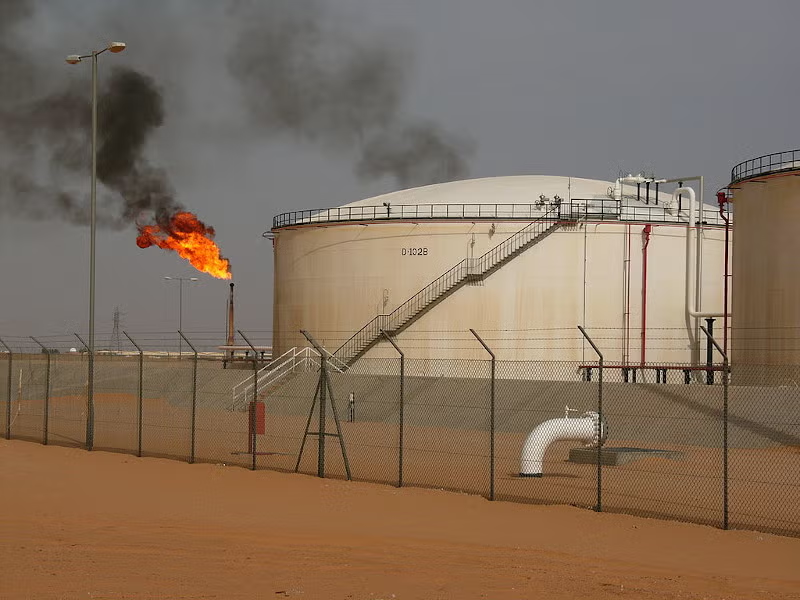
The fire that broke out on Sharara’s export pipeline this week did not produce the kind of dramatic shutdown headline that often defines Libya’s oil story. According to the National Oil Corporation, the blaze was caused by a valve leak, there were no casualties, and flows were redirected through alternative pipelines so production could continue while maintenance and damage assessments were carried out. For a field with capacity of roughly 300,000 to 320,000 barrels per day, that distinction matters.
In one sense, this is reassuring news. Libya avoided a full outage at its largest oil field, and NOC’s ability to reroute crude through the El Feel line to Mellitah and via Hamada to storage in Zawiya suggests that parts of the system still remain operational. At a time when oil is trading near the $100 Brentmark, that is more than a technical success. At 300,000 barrels per day, a full shutdown would imply around $30 million a day in gross crude value before costs and discounts, which shows how quickly even a short disruption at Sharara can become economically impactful.
But the deeper significance of the incident lies elsewhere. What happened at Sharara is a reminder that Libya’s oil vulnerability is not only political, and not only visible when production collapses outright, but also infrastructural. This means the real risk can sit quietly in the transport system itself, only becoming obvious when a leak, a fire, or a weak point suddenly interrupts the normal movement of crude.
That is an important shift in perspective. Observers usually explain Libya’s oil disruptions through protests, blockades, and force majeure, and Sharara has experienced each of them. Reuters reported in January 2024 that protests in Fezzan shut the field completely and led NOC to declare force majeure, while renewed unrest in the south cut production again later that year. Those episodes were clearly political in nature and easy to identify as such.
This week’s fire belongs to a different category. It does not point first to a standoff on the ground or to a closure imposed from outside. Instead, it draws attention to the quieter economics of infrastructure integrity. A field can remain productive, open, and commercially valuable, yet still become vulnerable if the network of pipelines, valves, and storage links that carries its crude is under strain. In oil producing countries, those midstream assets rarely receive the same attention as output figures, licensing rounds, or export revenues, but they are what turn production capacity into reliable supply.
Libya has experienced signs of all this before. In May 2025, an oil leak forced the shutdown of a pipeline south of Zawiya, where the country’s largest functioning refinery, with capacity of 120,000 barrels per day, is linked to crude flows from Sharara and Hamada. NOC moved quickly to stop the leak and contain the environmental damage, but the event still served as a reminder that technical failures can create economic risk even when they do not become full scale national crises.
Taken together, these incidents suggest that Libya’s oil challenge is broader than the headline cycle often implies. The country is not only managing the risk of sudden stoppages. It is also managing the slower, less dramatic problem of continuity, which in many ways is just as important. Buyers care about barrels, but they also care about confidence. Even when output continues, repeated infrastructure incidents can still shape perceptions of reliability, raise questions about maintenance and monitoring, and remind the market that resilience depends on more than what the field itself can pump.
None of this means the Sharara fire should be read as evidence of systemic failure. In fact, the opposite reading is partly true as well. Libya did not lose full production, and that says something useful about the adaptability of the current network. The country was able to limit the immediate damage through rerouting, which is exactly what redundancy is meant to do. That is worth emphasizing, particularly in a sector where even temporary outages can unsettle revenue expectations and export schedules.
Still, the episode leaves behind a clear economic lesson. Libya’s oil future will depend on more than the size of its reserves or the headline level of its output. It will depend just as much on whether crude can move safely, consistently, and at low enough operational risk from field to terminal. New exploration rounds and fresh upstream ambitions can attract attention, but they sit on top of a more basic requirement: the physical network has to keep working under pressure.
That is what makes the Sharara incident more than a one day operational update. The field stayed online, and that is the immediate good news. Yet the fire also highlighted a quieter truth about Libya’s oil economy. Its greatest vulnerabilities may not always arrive in the form of dramatic shutdowns. Sometimes they appear in the technical weak points that do not stop the system outright, but still reveal how much depends on infrastructure that must work flawlessly every day.
Sharara did not go offline, and that is precisely why this story deserves attention. Libya’s oil resilience depends not only on how much the country can produce, but on how well the system absorbs disruption before a technical incident turns into a wider economic loss.