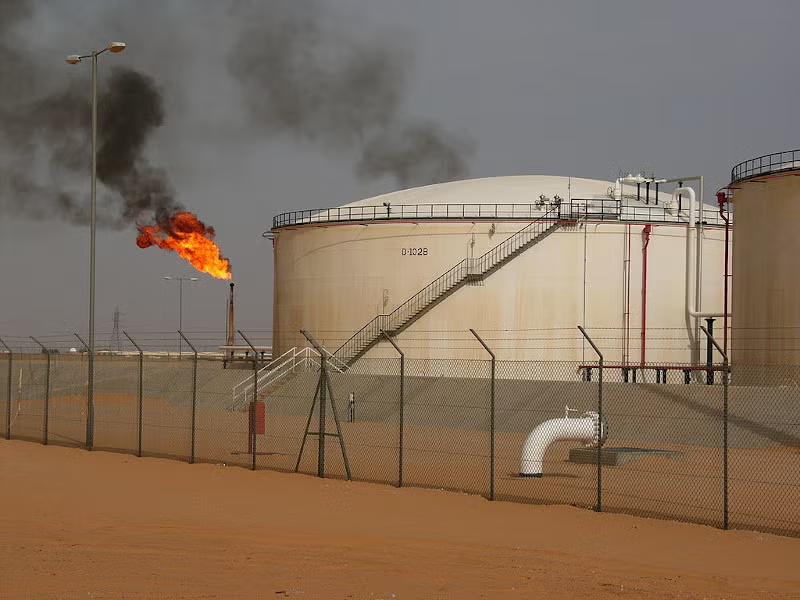
Last week’s fire on the Sharara export pipeline first looked like another case of technical strain inside Libya’s oil system. The National Oil Corporation said a leak at a pipeline valve caused the blaze near Bir al Marhan in Hamada, and it moved quickly to reroute flows in order to keep production going.
That explanation no longer stands on its own.
Libya’s Tripoli based interior ministry has now said security authorities recovered two exploded projectiles from the damaged Sharara pipeline site. Reuters reported that officials identified the remnants as an M 62 Russian made missile weighing about 250 kilograms and parts of a 130 mm rocket. That discovery has sharply raised the likelihood that the incident involved sabotage rather than a simple technical fault.
Even so, one point still needs care. Public reporting has not yet fully established whether the projectiles directly caused last week’s fire, whether investigators found them during a later inspection of the same site, or whether they point to a separate attempt to strike the same infrastructure. That gap matters because it shapes how the market, operators, and policymakers interpret the risk.
For Libya, the bigger issue is no longer just what started the fire. The real issue is what the changing official narrative reveals about the country’s oil security posture.
If the initial explanation proves incomplete, the episode will expose a familiar weakness in Libya’s crisis management. Officials often move first to stabilize operations and calm markets. That instinct makes sense. But when new evidence later changes the picture, the result is confusion rather than reassurance. In a sector as strategic as oil, credibility matters almost as much as output.
Sharara is not a minor asset. It is Libya’s largest oil field and one of the country’s most important production centers. Any disruption there carries weight far beyond the field itself. When the fire damaged the export line, NOC redirected Sharara crude through alternative routes, including the El Feel pipeline to Mellitah and the Hamada line toward storage in Zawiya. That response kept Sharara flowing, but it created pressure elsewhere in the system.
That pressure soon became visible. Reuters reported that El Feel shut down after NOC used its pipeline capacity to move Sharara crude. Engineers said the field had remained offline since Thursday and could need a week to ten days to resume. In other words, a single incident at Sharara did not stay contained. It spread across connected infrastructure and disrupted another producing asset.
That is what makes this story important for LER’s audience. The new sabotage claims do not replace the infrastructure angle. They deepen it. Libya’s oil sector now appears exposed on two fronts at once. It faces aging systems and operational bottlenecks, but it also faces the risk of deliberate disruption. Each threat amplifies the other.
This matters for investors as much as for operators. Oil markets can absorb technical faults. They treat sabotage differently. Technical failures suggest maintenance problems. Suspected attacks point to a broader security environment that can interrupt production, raise insurance costs, and weaken confidence in future output targets. Libya has spent years trying to present its oil sector as resilient despite political division. Incidents like this make that argument harder to sustain.
The state also faces a governance test. If officials want to contain the damage from this episode, they will need to do more than repair the pipeline. They will need to explain clearly what happened, when the projectile evidence emerged, and how security agencies plan to protect critical energy infrastructure going forward. A vague shift from “valve leak” to “projectiles found” will not be enough. The issue now is not only physical security. It is institutional trust.
The Sharara case may still end without a prolonged loss of production. But the latest claims have already changed its meaning. What first looked like a technical incident now points to a deeper problem at the intersection of infrastructure fragility, security risk, and official transparency. For Libya’s oil sector, that combination may prove more damaging than the fire itself.