Will Greece Succeed in Turning the “Mediterranean Dispute” into a Structural Partnership with Libya?
Greek Foreign Minister George Gerapetritis made the economic importance of his visit to Libya clear when he visited Benghazi in eastern Libya. There, he met with Field Marshal Khalifa Haftar, commander of the Libyan National Army, as well as the chairman of the Foreign Affairs and International Cooperation Committee in the House of Representatives and the chairman of the Committee on Frozen Assets in Libya.
The visit clearly aimed to go beyond traditional diplomacy and touch the core of strategic economic interests in the eastern Mediterranean basin. Gerapetritis referred to what he described as large Greek investments in eastern Libya, underlining the growing importance of trade between the two sides.
Geography imposes a reality that cannot be ignored. Libya is the closest country to Greece in the Mediterranean. This makes the development of commercial activity between them an economic necessity.
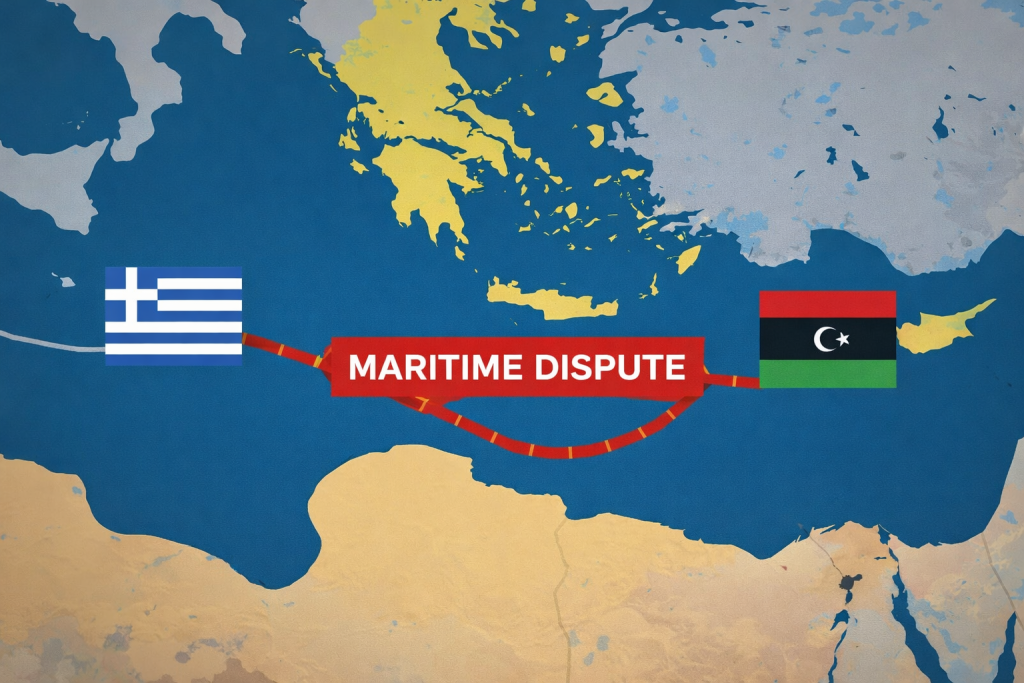
The visit also covered political and security issues, including irregular migration. Still, it highlighted the importance of maritime border demarcation between Greece and Libya, including the exclusive economic zone and the continental shelf. These issues remain the main driver of the Greek move.
Athens wants to persuade the Libyan side to begin technical negotiations on maritime border demarcation. This step would help Greece, both legally and economically, challenge the Turkish Libyan memorandum signed in 2019 with the former Government of National Accord under Fayez al Sarraj. The interim Government of National Unity under Abdul Hamid Dbeibeh later adopted that memorandum. Athens still considers it null and void and continues to demand its cancellation.
In return, Greece believes that an agreement with Libya would strengthen its rights to gas exploration south of Crete. But this objective collides with the fact that both sides want to issue exploration licenses in legally stable areas. European studies also warn that competition in the eastern Mediterranean could affect stability in Libya.
For Libya, clear demarcation could open the door for international oil companies such as Total and Eni to begin large scale exploration in offshore areas that remain disputed. That could bring in billions of dollars in direct foreign investment.
The visit offers a chance to transform a maritime dispute into an economic partnership within a changing regional energy landscape. Athens wants to expand its investment presence in Libya’s reconstruction in exchange for a legal solution to the maritime border issue. Such a move could open the door to hydrocarbon development and renewable energy projects.
This approach is not surprising. Greece places the electricity interconnection project with North Africa high on its agenda. It sees Libya as a source of renewable energy because of its large solar potential. Greece also wants to position itself as the gateway through which this green energy reaches European markets. Libya targets 4 gigawatts of solar capacity by 2035, while Greece has the interconnection expertise to act as Libya’s bridge to Europe.
The trade figures show that the economic relationship no longer sits at the margins. It is growing quickly and reflects a broader shift in the nature of bilateral ties. Libyan exports to Greece reached about $2.6 billion in 2024, mostly crude oil. Greek exports to Libya reached about $1.1 billion. This brought total annual trade to around $4 billion.
These figures place Libya among Greece’s most important energy suppliers. In turn, they make Greece a potential European gateway for Libyan oil and gas, especially as Europe continues to diversify energy sources after recent international crises.
This expansion reflects a shift from simple trade to a more structural economic partnership. Through that partnership, Greece seeks to deepen its role in the Libyan economy and gain influence that extends beyond commerce into the strategic sphere.
That shift has already started to take shape. In January, ADMIE or IPTO, the Greek Independent Electricity Transmission Operator, signed a memorandum of understanding with the Libyan Reconstruction and Development Fund, which is based in Benghazi. The agreement aims to modernize and digitize Libya’s electricity network. Many see this as a first step toward linking Libya to Mediterranean power networks through Crete or Greece.
Metlen Energy & Metals has also signed memoranda for thermal power stations, solar projects, and battery storage. TERNA is also participating in renewable energy and major infrastructure projects.
As Europe seeks to reduce dependence on Russian gas after the Ukraine war and amid the fallout from the American Israeli war on Iran, the Libya Greece interconnection project takes on greater strategic value. Both sides seek to build a stable energy corridor in the eastern Mediterranean. Such a corridor could connect Libya’s large oil and gas reserves to Greek and wider European networks.
Despite the postponement of the Greek foreign minister’s visit to Tripoli due to weather, the visit will take place later. Greece plans to present the Government of National Unity with an economic offer that includes cooperation on maritime demarcation, major investment in energy and reconstruction, and political support in Brussels.
Economic moves, however, cannot be separated from maritime sovereignty. Exclusive economic zones remain at the center of competition in the eastern Mediterranean. Dbeibeh has stressed the need to preserve Libya’s sovereign rights in its territorial waters and to respect the international laws and agreements that protect national interests.
The biggest obstacle remains Libya’s institutional division. That division could hinder the signing of long term, legally binding economic agreements.
The ideas and concepts expressed in this piece are those of the author and do not necessarily reflect the positions of Libya Economic Review. If you would like to contribute to LER, contact us at younis@libyaeconomicreview.com.