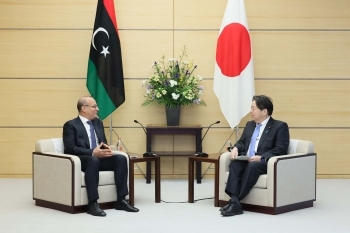
Libya has stepped up efforts to attract foreign investment in its energy sector, with the government now targeting Japan as part of a broader push to diversify international partnerships and unlock new capital flows.
The move comes as Economy Minister Suhail Abu Shiha invited Japanese companies to participate in upcoming public tenders in energy and infrastructure during talks with Japan’s ambassador to Libya. The outreach signals a shift in Libya’s economic strategy. Tripoli is no longer relying only on traditional European partners. It now seeks deeper engagement with Asia-Pacific markets, where capital, technology, and long-term energy demand align with Libya’s development needs.
A Strategic Pivot Toward Asia
Libya’s engagement with Japan reflects a calculated pivot. Officials acknowledge that economic ties between the two countries remain limited, despite clear potential.
That gap creates an opportunity. Japan brings advanced engineering, strong financing capacity, and a track record in large-scale energy and infrastructure projects. For Libya, these capabilities matter. The country needs technical expertise to modernize oil fields, expand gas infrastructure, and improve power generation.
At the same time, Japan seeks stable long-term energy partnerships. Libya’s vast hydrocarbon reserves make it an attractive option. The country holds one of Africa’s largest oil reserves and relies heavily on energy exports to drive its economy.
This alignment of interests could form the basis for a deeper economic relationship.
Energy at the Core of Investment Strategy
Energy remains central to Libya’s investment narrative. The government continues to position the sector as the primary entry point for foreign companies. Recent discussions with Japanese officials focused not only on new tenders but also on developments in Libya’s oil investment landscape. These include the results of a bidding round launched earlier this year, which has already attracted international partnerships.
That momentum matters. Libya wants to signal that its investment environment is improving. By highlighting successful bidding rounds, the government aims to build credibility and reduce perceived risk for new entrants.
The focus on infrastructure also expands the opportunity. Energy investment in Libya no longer stops at upstream oil production. It now includes pipelines, refining, electricity generation, and logistics—areas where Japanese firms can play a major role.
The Challenge of Credibility
Despite the opportunity, Libya faces a familiar challenge: investor confidence.
Political fragmentation and institutional uncertainty continue to shape perceptions of risk. The energy sector remains highly exposed to disruptions, whether from local tensions or governance disputes. These factors have historically limited foreign investment, even when commercial conditions looked favorable.
Officials recognize this constraint. Talks with Japan included discussions on memoranda of understanding and framework agreements aimed at improving transparency and streamlining procedures. These steps matter, but they will not deliver immediate results. Investors require more than agreements. They look for consistency in policy, clarity in regulation, and stability in operations. Libya must demonstrate progress on all three fronts to convert interest into long-term investment.
Diversification Beyond Traditional Partners
Libya’s outreach to Japan also reflects a broader geopolitical shift. The country is actively diversifying its economic partnerships beyond Europe and the Mediterranean. Recent engagements with countries across Asia and Africa show a clear pattern. Tripoli aims to reduce reliance on a narrow group of partners and build a more balanced investment portfolio.
This strategy offers several advantages. It increases competition among investors, which can improve deal terms. It expands access to new technologies and financing models. It also strengthens Libya’s position in global trade by linking it to faster-growing markets.
However, diversification carries risks. Managing multiple partnerships requires stronger institutions and clearer coordination. Without these, Libya could struggle to translate agreements into tangible projects.
A Window of Opportunity
The timing of Libya’s outreach to Japan is significant. Global energy markets remain volatile, and demand for diversified supply sources continues to rise. This environment creates a window for Libya to reposition itself as a competitive investment destination.
At the same time, domestic conditions show signs of gradual improvement. Increased production, renewed bidding activity, and expanded diplomatic engagement all point to a more proactive economic strategy. Still, the window will not remain open indefinitely.
Other energy producers are also competing for investment. Countries with more stable regulatory frameworks and stronger infrastructure may attract capital faster.
The Bottom Line
Libya’s invitation to Japanese firms highlights both ambition and necessity. The country needs foreign investment to modernize its energy sector and sustain economic growth. Japan offers capital, technology, and long-term partnership potential.
But success depends on execution. Libya must move beyond outreach and deliver a stable, transparent investment environment. It must turn agreements into projects and interest into capital flows.
If it succeeds, this shift toward Asia could mark a turning point in Libya’s economic strategy. If it fails, it risks reinforcing long-standing doubts about its ability to attract and retain global investment. For now, the signal is clear: Libya is open for business, but investors will wait to see if the conditions truly support it.