Libya and South Korea are preparing to hold an economic cooperation forum in Libya on September 28, as both sides look to expand trade, investment and business ties and bring Korean companies back into the Libyan market.
The forum was discussed during a meeting between Ashraf Mohamed Al-Taib, Director of the International Cooperation Department at Libya’s Ministry of Foreign Affairs and International Cooperation, and Cho Woo-seok, Chargé d’Affaires of the South Korean Embassy in Libya. The two officials reviewed the technical, organizational and protocol arrangements for the event.
The September 28 meeting is expected to include direct discussions between Libyan and Korean institutions and companies. The two governments want those meetings to produce practical outcomes rather than remain at the level of diplomatic exchanges.
That distinction matters for Libya. Korean companies have extensive experience in large-scale construction, infrastructure, engineering, energy and industrial projects, while Libya needs capital and technical expertise to rebuild and expand much of its economic infrastructure.
From diplomacy to business
The forum comes after several months of renewed contact between Libya and South Korea.
In April, Libya’s Ministry of Economy and Trade discussed expanding economic and trade cooperation with a South Korean delegation, with particular attention to investment and the return of Korean companies to Libya. The ministry also called for greater business-to-business links through economic exhibitions and conferences. Libya’s state news agency LANA reported that Libya invited Korean companies that had previously worked in the country to resume operations.
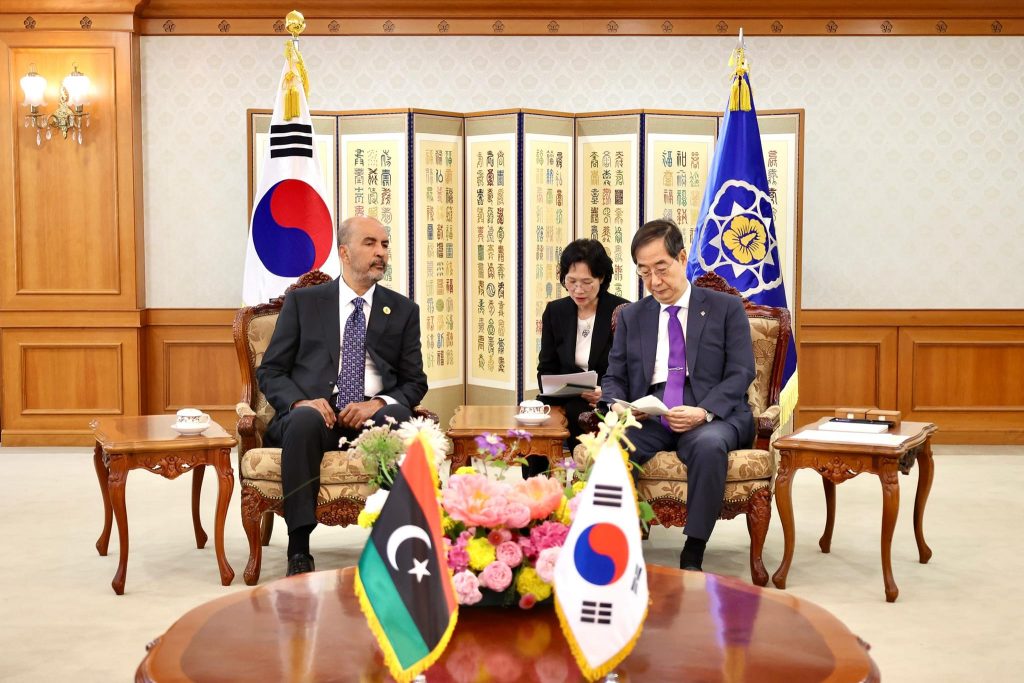
That push gained further momentum in June. South Korea’s Foreign Ministry said Vice Foreign Minister Park Yoon-joo discussed expanding the presence of Korean companies in Libya during a meeting with Libya’s Minister of State for African Affairs, Fath Allah al-Zani. Seoul specifically highlighted opportunities in Libya’s crude oil and oil refining sectors, while the Libyan side expressed interest in Korean investment in construction and infrastructure.
The same meeting also produced an important diplomatic development: South Korea announced the reopening of its embassy in Tripoli, after it had operated on a rotational basis between Libya and Tunisia since 2022. The South Korean Foreign Ministry said the reopening should provide a stronger foundation for bilateral cooperation.
The sequence of meetings suggests that the September forum is part of a wider effort to rebuild a commercial relationship that once played an important role in Libya’s development.
Energy and infrastructure are key
The potential areas for cooperation extend well beyond trade. South Korean companies have a long history in Libya’s infrastructure and energy sectors. Korean contractors were involved in the Great Man-Made River project, one of Libya’s largest infrastructure programs. South Korea’s Foreign Ministry has also identified crude oil and refining as areas where Korean companies could expand their presence.
For Libya, the attraction is clear. The country needs investment in oil and gas infrastructure, electricity generation, transport, water systems, housing and industrial facilities. Korean engineering and construction companies could compete for some of these projects if Libya can provide a workable investment environment and sufficient project financing.
The opportunity also extends to Libya’s energy transition. While oil and gas will remain central to the economy, the country faces growing demand for electricity and needs to improve generation capacity, transmission networks and industrial efficiency. Korean companies have capabilities across power, engineering, manufacturing and technology that could fit some of these requirements.
For Korean firms, Libya offers a different proposition: access to a market with major reconstruction and infrastructure needs, as well as one of Africa’s largest oil reserves.
But the size of the opportunity does not automatically make projects bankable. Investors will still look at payment security, procurement rules, contract enforcement, access to foreign currency, project financing and the broader political and security environment. Those issues will matter more than the forum itself once companies begin evaluating specific projects.
Will the forum produce deals?
The most important part of the September 28 event may therefore happen in the bilateral meetings.
Libya and South Korea are already discussing direct meetings between companies and institutions. If those meetings result in memoranda, feasibility studies, investment agreements or project discussions with clear timelines, the forum could become a useful commercial platform.
The proposed reciprocal visa exemption for holders of diplomatic and special passports could also make official exchanges easier, although the proposal still needs to move through the appropriate government channels. It would not directly resolve the practical requirements facing private-sector investors, but easier official travel could support more frequent government and business contacts.
For Libya, attracting Korean companies would also diversify its pool of international partners. European, Turkish, Chinese and Gulf companies already have significant interests in the country. A deeper Korean presence would give Libyan institutions another source of capital, technology and industrial expertise.
The September forum therefore gives both sides a test. For Libya, the question is whether it can convert interest from Korean companies into projects that actually move forward. For South Korea, the key issue will be whether Libya can provide the operating and investment conditions needed to justify a larger commercial presence.
The first signs should come from what the two sides announce after September 28: not simply the number of companies attending, but the projects discussed, contracts pursued and commitments that survive beyond the forum.