US oil companies in Libya are expanding their interest in a sector that offers significant exploration potential but still faces political and operational risks. In February 2026, Chevron secured an exploration area in the Sirte Basin, marking a return to Libya after a 16-year absence. The move adds a new American player to a sector where ConocoPhillips already holds interests through its partnership with Libya’s National Oil Corporation (NOC) and France’s TotalEnergies.
The renewed interest raises an important question: can American energy companies help Libya increase oil production, and what will it take to turn exploration plans into lasting investment?
Chevron and ConocoPhillips: The US Presence in Libya’s Oil Sector
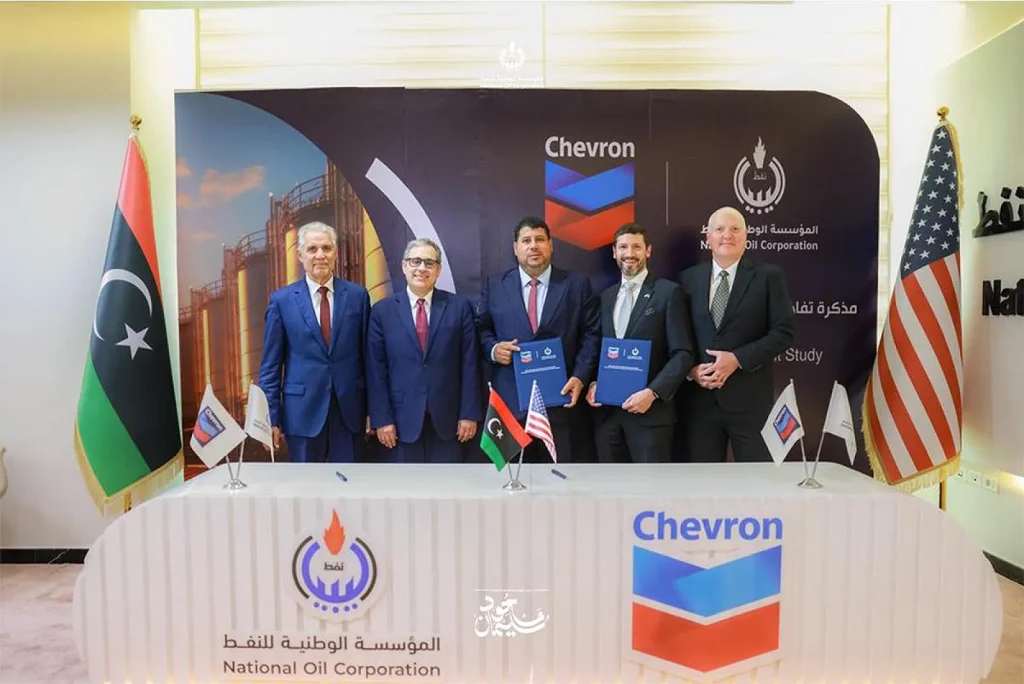
Chevron’s return marks a significant development for Libya’s oil industry. On February 11, the company announced that it had won Contract Area 106 in the Sirte Basin through Libya’s 2025 licensing round. Chevron had signed a memorandum of understanding with the NOC on January 24 to assess onshore exploration and development opportunities.
The award gives Chevron a new opportunity to explore one of North Africa’s most important petroleum regions. However, an exploration license does not guarantee a commercial discovery. The company must assess geological prospects, conduct exploration work and determine whether potential reserves justify the cost of development.
Chevron’s entry also signals renewed international interest in Libya’s upstream oil and gas sector. Libya held its first major licensing round in years in 2025, attracting several international companies. The NOC aims to increase production and develop fields that could support higher output over the coming years.
Chevron’s announcement provides details of the award and the company’s plans. ConocoPhillips, meanwhile, has a longer-established presence through the Waha concession, where it partners with the NOC and TotalEnergies. Waha operates several major oilfields and continues to pursue drilling, maintenance and production-growth projects. In August 2026, the NOC reported that Waha produced around 357,000 barrels per day and planned further output gains through development drilling and work on existing wells.
This existing production gives ConocoPhillips a different role from Chevron. While Chevron begins evaluating a new exploration area, ConocoPhillips works with its partners to develop established assets and increase production from existing fields.
Together, the two companies illustrate the range of American commercial interests in Libya, from finding new reserves to improving output from producing assets.
Why Libya Attracts US Oil Companies, and What Could Hold Them Back
Libya offers several advantages for international energy companies. Its large hydrocarbon resources, established export infrastructure and access to Mediterranean markets make it an attractive location for exploration and production. Higher output could also support Libya’s public finances, which depend heavily on oil and gas revenue.
For US companies, investment in Libya provides an opportunity to expand their portfolios while working with the NOC, the country’s central oil-sector institution. New exploration projects could identify additional reserves, while investment in existing fields could help raise production without relying entirely on new discoveries.
Yet Libya’s resource potential does not remove the risks. Political divisions, disputes over public institutions, security threats and recurring oilfield disruptions can complicate long-term planning. Companies must also assess contract terms, infrastructure reliability, payment risks and the practical conditions for operating across the country.
The US Department of State’s 2024 Investment Climate Statement on Libya highlights concerns about bureaucracy, corruption, institutional divisions and contractual uncertainty. Although the report predates Chevron’s latest award, these issues remain important considerations for investors.
Libya also needs more than new exploration licenses to achieve sustainable production growth. It must maintain pipelines and export terminals, improve field infrastructure, fund development projects and reduce interruptions that prevent companies from operating consistently. New discoveries will contribute little to near-term output if operators cannot develop them commercially or move the oil reliably to export markets.
The distinction matters for Libya’s economic outlook. Higher production can increase export earnings, but the country also needs reliable investment and stronger management of its oil revenue to translate additional output into broader economic gains.
Chevron’s return and ConocoPhillips’ existing operations show that US companies continue to see opportunities in Libya’s energy sector. Their long-term commitment, however, will depend on commercial results and the country’s ability to provide a more predictable operating environment.
Libya has the resources to attract further American investment. The next test is whether it can turn renewed interest into sustained production, stronger infrastructure and more reliable oil revenue.