Italy has brought its largest national business delegation to the Libya Construction Expo in Tripoli, with 17 companies looking to expand commercial opportunities in the country’s construction, engineering and building materials markets. The participation reflects growing Italian interest in Libya’s infrastructure and property sectors as bilateral trade accelerates and both countries seek closer economic ties beyond oil and gas.
The ninth edition of the Libya Construction Expo opened on November 8 at the Tripoli International Fairgrounds, bringing together 155 Libyan and international companies. The event features five national pavilions representing Italy, Türkiye, India, Egypt and Tunisia, and runs until November 11.
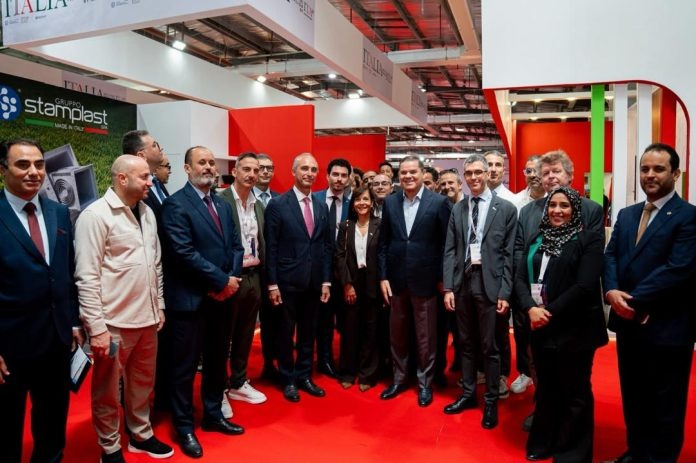
Italy’s pavilion covers 230 square meters and brings together 17 companies across the construction supply chain, including building materials, finishing products and construction technologies. The Italian Trade Agency (ITA), working with industry associations Finco and Confimi Edilizia, organized the pavilion.
Prime Minister Abdulhamid Dbeibah attended the opening alongside several government ministers and Italy’s Ambassador to Libya, Gianluca Alberini. Dbeibah and Alberini also visited the Italian pavilion and met representatives of the participating companies.
According to the Italian Embassy, this marks the first time Italy has organized an official national pavilion at the Libya Construction Expo. Architect Alessandro Colombo, Ambassador of Italian Design worldwide, will also participate in the accompanying Design and Architecture Forum, presenting developments in architecture and Italian manufacturing.
Italian Companies Target Libya’s Construction Market
The participating companies cover several areas of the construction industry, from machinery and engineering to doors, windows, building equipment and interior design.
Their participation gives Libyan businesses access to Italian suppliers and specialized technologies across different stages of construction. It also creates opportunities for commercial partnerships, supplier agreements and direct business-to-business meetings.
The delegation includes companies such as ATP Technologies, Bertolotto, Condor, Davi-Promau, Eurimpianti, Faresin Formwork, GBM Building Equipment, Luxury Windows Italia and Webert Industry.
Italy’s presence in Tripoli follows its participation in Libya Build in Benghazi last April. The Italian Trade Agency has increasingly used local exhibitions to introduce Italian manufacturers to Libyan buyers and explore opportunities in infrastructure, residential construction and commercial development.
The strategy also reflects Italy’s efforts to diversify its economic relationship with Libya. Energy remains central to bilateral relations, particularly through Italian energy company Eni, but construction, manufacturing, engineering and industrial services offer additional areas for cooperation.
Trade Growth Strengthens the Commercial Relationship
The growing business presence comes as trade between Italy and Libya continues to expand.
According to figures published by Italy’s Ministry of Foreign Affairs, bilateral trade reached €5.7 billion in the first half of 2026, representing a 43.4% increase compared with the same period last year.
Italian exports to Libya rose by 92.7% to €1.697 billion, compared with €881 million in the first six months of 2025. Italy remains Libya’s largest trading partner, accounting for 17% of the country’s imports and 23.4% of its exports.
These figures highlight the scale of commercial opportunities between the two countries. They also provide a stronger foundation for Italian companies seeking to establish longer-term relationships with Libyan businesses.
For Libya, attracting foreign construction companies could support efforts to rebuild infrastructure, improve housing and expand commercial and industrial facilities. Demand extends beyond major public projects to include building materials, machinery, engineering services and modern construction technologies.
However, greater business participation does not automatically translate into investment or completed projects. Foreign companies still need predictable regulations, reliable payment arrangements, clear procurement processes and confidence that projects will move forward.
Libya also needs to ensure that international partnerships create opportunities for domestic manufacturers, contractors and workers rather than relying entirely on imported materials and foreign expertise.
The recent Libyan-Italian business forum in Misrata, which brought together around 60 Italian companies and institutions, reflects a similar push to expand cooperation across industry, logistics and infrastructure.
The challenge now is to turn growing commercial interest into contracts, investment and productive activity inside Libya. Italy’s participation in the construction exhibition provides another opportunity to build those connections, but the longer-term value will depend on whether business meetings lead to projects that deliver measurable results for both economies.