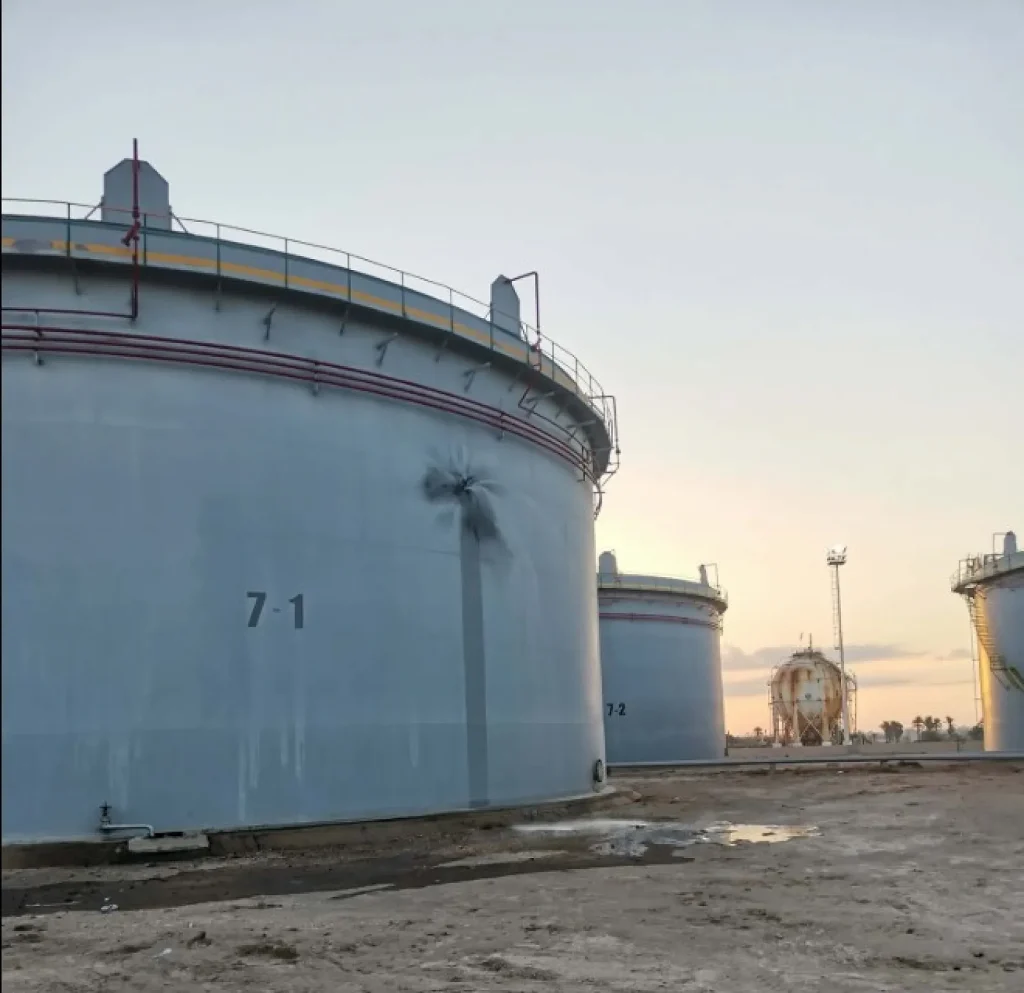
A drone crashed into a fuel tank at Libya’s Zawiya refinery early Saturday, causing a naphtha leak and damaging the tank. Refinery teams quickly contained the leak, while authorities reported no injuries or fire.
The incident highlights the security risks facing one of Libya’s most important petroleum facilities. The Zawiya refinery sits at the center of the country’s western energy infrastructure and plays a key role in supplying refined petroleum products to the domestic market.
According to the Zawiya Oil Refining Company, the drone struck untreated naphtha tank No. 1-7 during the early morning hours. The impact created two holes in the tank and caused naphtha to leak. Refinery workers responded immediately and stopped the flow. The company said the situation remained under control and confirmed that no workers suffered injuries.
The Petroleum Facilities Guard’s First Support Battalion later documented the incident and identified the aircraft as an FPV drone. Authorities recorded the damage to the tank, the crash site and the drone wreckage. The guard said technical and investigative procedures must now establish the circumstances surrounding the crash and identify those responsible.
Drone Incident Raises Fresh Security Concerns
The incident comes as Zawiya continues to face security tensions. Armed clashes in and around the city have previously disrupted movement and raised concerns about the safety of critical infrastructure.
Those concerns extend directly to the refinery. The Zawiya Oil Refining Company has previously warned about the presence of military equipment and armed activity around its facilities, arguing that such activity puts workers, infrastructure and the surrounding environment at risk. Saturday’s incident demonstrates how those security concerns can translate into direct operational risks.
A drone reached a fuel-storage area inside the refinery and damaged a tank containing a flammable petroleum product. Although workers contained the leak before it developed into a larger incident, a different outcome could have caused a fire, damaged nearby equipment or forced a wider shutdown.
The absence of casualties and the rapid containment of the leak therefore limit the immediate impact. However, the incident still exposes a vulnerability that energy companies and authorities cannot ignore. That vulnerability becomes more important because the refinery does not operate in isolation. Zawiya forms part of a wider network of oil infrastructure that supports Libya’s western fuel supply. Any disruption at the refinery can therefore affect operations beyond the damaged tank itself.
Why Zawiya Refinery Matters to Libya’s Fuel Market
Zawiya refinery has a strategic position in Libya’s domestic energy system. Its location in western Libya allows it to support fuel supplies to major population centers and connect with other parts of the country’s petroleum infrastructure.
This makes the refinery’s reliability particularly important for Libya’s fuel market. Libya produces large volumes of crude oil, yet the country still relies heavily on imported petroleum products. Limited domestic refining capacity and recurring infrastructure problems have made fuel imports an important part of the country’s energy balance.
That means an extended disruption at Zawiya could create pressure elsewhere in the supply chain.
Damage to a single storage tank may have a limited effect if operators can isolate the affected facility and continue normal operations. A more serious incident, however, could disrupt refinery throughput, fuel storage or distribution. That could force the authorities to rely more heavily on imports to cover domestic demand. The distinction matters for Libya because refinery disruptions can affect the economy even when crude production remains stable.
Oil production generates the bulk of Libya’s export earnings and government revenue, but the country also needs functioning downstream infrastructure to turn crude into usable products and move those products to consumers. Security at refineries, storage facilities and distribution networks therefore forms an important part of the broader energy equation.
The Zawiya incident shows how a localized security event can create risks further down that chain.
Protecting Energy Infrastructure Becomes More Critical
The incident also comes at a significant time for Libya’s oil sector. The National Oil Corporation is seeking to increase crude production and attract new investment into exploration and development.
Higher production, however, requires more than successful drilling and field development. Libya also needs secure pipelines, export terminals, storage facilities, refineries and transport networks capable of supporting higher volumes.
That makes infrastructure security increasingly important as the country attempts to expand its oil output. The drone incident highlights a particular challenge. FPV drones are relatively small and can reach sensitive industrial areas without the physical scale of a conventional attack. Even limited damage can create operational, environmental and safety risks when the target contains flammable petroleum products.
For refinery operators, that means security cannot focus only on preventing large-scale attacks. They also need to consider smaller threats that could disrupt individual tanks, processing units or other critical components.
The Petroleum Facilities Guard said oil installations represent a fundamental part of Libya’s national economy and stressed the importance of protecting them. The investigation into the Zawiya incident should now help authorities determine exactly how the drone reached the refinery and whether the event resulted from deliberate targeting or another cause.
For now, the immediate situation remains contained. Workers stopped the naphtha leak, the refinery reported no injuries and no fire, and the damaged tank remains the focus of the response. The broader lesson, however, extends beyond one tank.
As Libya works to increase oil production and strengthen its energy sector, protecting the infrastructure that processes, stores and distributes petroleum products will become just as important as increasing output. The Zawiya incident provides another reminder that energy security in Libya depends not only on how much oil the country produces, but also on its ability to keep critical energy infrastructure operating safely.