For years, public debate in Libya has focused on cash liquidity. Yet experience has shown that the deeper problem was never simply a shortage of cash. It was the lack of reliable and efficient digital alternatives capable of reducing dependence on it.
Today, that picture is beginning to change.
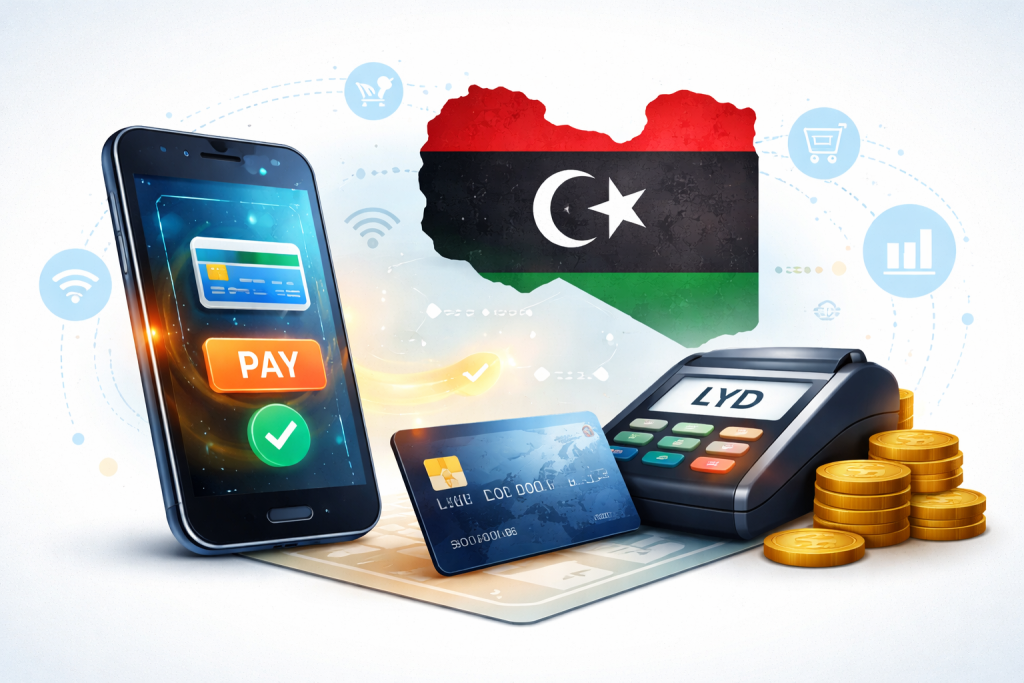
In recent years, Libya’s electronic payments ecosystem has expanded noticeably. Mobile banking applications and point of sale, or POS, devices are becoming a more visible part of daily life across many cities.
According to data from the Central Bank of Libya, the number of POS devices nationwide has surpassed 165,000, up from around 150,000 a year earlier. Transactions processed through these devices exceeded 288 million, with a total value of nearly LYD 37.8 billion in 2025.
On the digital banking side, more than 4.3 million users are now registered on mobile banking applications, with transaction values reaching approximately LYD 47.9 billion. In addition, the number of active bank cards has exceeded 5.5 million.
These figures suggest that Libya’s shift toward digital payments is no longer theoretical. It is already underway.
Still, this shift should be assessed with caution.
Beyond the numbers: a limited digital shift
Despite these strong growth indicators, Libya’s banking sector is not yet undergoing a full digital transformation. What is taking place today is closer to digitization than genuine transformation.
Banks have made visible progress in launching mobile applications, expanding POS networks, and issuing payment cards. But in most cases, these efforts amount to a digital layer placed on top of traditional systems rather than a fundamental redesign of banking operations, customer journeys, or decision making processes.
In other words, the interface has evolved, while the core remains largely unchanged.
Infrastructure expansion versus operational efficiency
The rapid growth of payment infrastructure does not automatically translate into dependable performance or stronger user confidence.
Challenges remain clear, including network instability, system outages, and limited interoperability between banks. As a result, the key question is no longer how many devices have been deployed, but whether they work reliably when customers need them most.
Customer experience: the critical weak point
One of the most pressing, and often overlooked, challenges lies in user experience.
Many digital banking services still suffer from cumbersome onboarding, technical disruptions, and weak customer support. This friction discourages regular use and often pushes customers back toward cash.
Digital adoption is not driven by availability alone. It depends on simplicity, reliability, and consistency.
Trust: the invisible barrier
Beyond technology, trust remains a decisive factor in shaping user behavior.
For many Libyans, cash still represents certainty and control, while digital payments are often seen as carrying greater risk. Concerns about transaction errors, delayed resolutions, and limited transparency in handling disputes reinforce this perception.
Unless this trust gap is addressed, growth in digital payments may remain fragile and reversible.
A fragmented ecosystem
Another structural constraint is the fragmented nature of the banking ecosystem.
Banks continue to operate largely in silos, each developing its own digital platforms with limited interoperability. This lack of integration creates inconsistent user experiences and slows the emergence of a seamless national payment environment.
True digital transformation requires a system wide approach, not isolated institutional efforts.
Growth driven by necessity, not preference
A critical point is that much of the recent growth in digital payments appears to have been driven by necessity rather than genuine consumer preference.
Cash liquidity pressures have pushed users toward digital channels as an alternative, not necessarily because they see them as a better option. This raises an important strategic question: if cash availability improves, will users remain digitally engaged?
Without delivering clear and lasting value, current growth trends may prove difficult to sustain.
A window of opportunity
Despite these challenges, Libya still has significant potential to accelerate its digital transformation.
The country has a young and tech aware population, high smartphone penetration, and growing demand for e commerce and digital services. Together, these factors provide a strong foundation for future progress.
To make the most of this opportunity, banks should focus on four priorities: improving customer experience before adding more features, building trust through transparency and efficient dispute resolution, strengthening interoperability across the financial system, and turning POS usage from a substitute for cash into a genuine payment habit.
Conclusion: a transition in progress, not yet a transformation
Libya’s banking sector has made meaningful progress in expanding digital tools and payment infrastructure, but it has not yet achieved a fundamental shift in customer behavior or in the structure of the financial system itself. The real test now is whether banks can move beyond simply digitizing traditional services and begin building solutions that are reliable, integrated, and trusted enough to reduce the economy’s dependence on cash over the next five years. That is what will ultimately determine whether Libya’s current momentum becomes a genuine digital transformation or remains only a partial transition.