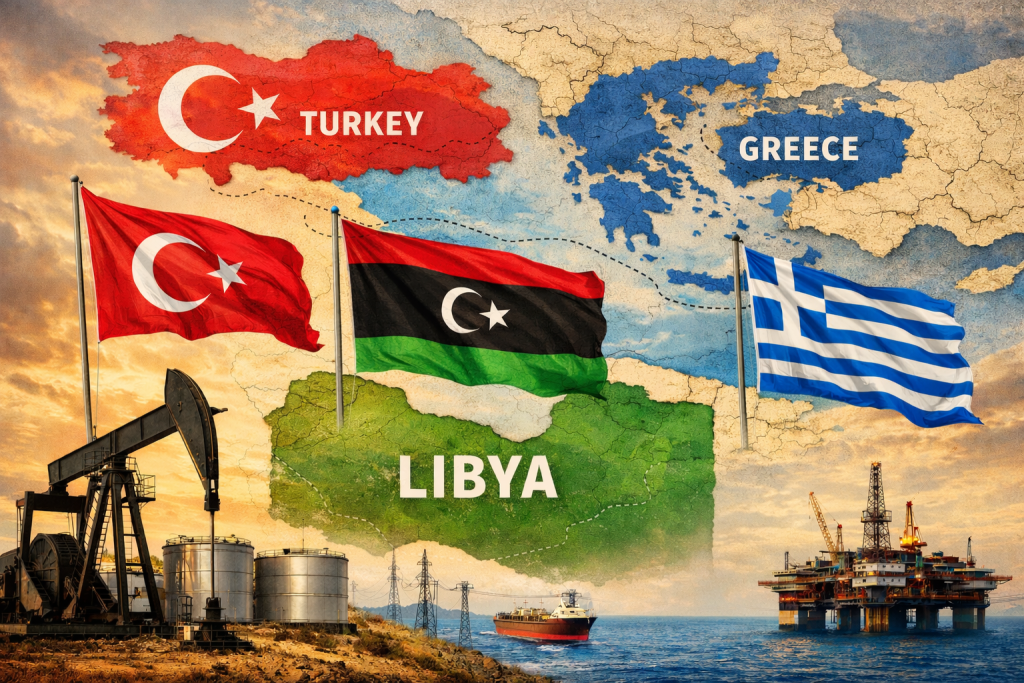
Libya as a Game Changer in the Turkey–Greece Energy Contest
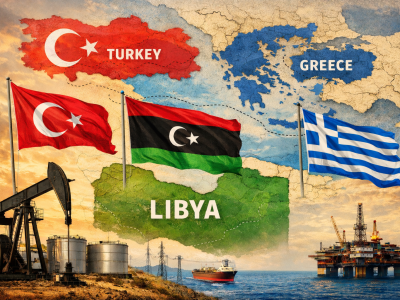
In the long-running geopolitical rivalry between Turkey and Greece in the Eastern Mediterranean, Libya has once again emerged as a pivotal actor.
Libya’s decision on February 11 to grant two exploration concessions to Turkish state oil company Turkish Petroleum Corporation (TPAO), alongside several American and Western firms, for onshore and offshore oil and natural gas exploration, was followed just days later—on February 16—by Greece’s granting of hydrocarbon exploration rights to a consortium led by Chevron.
These parallel developments have brought Libya back to the forefront of regional energy politics and maritime jurisdiction debates.
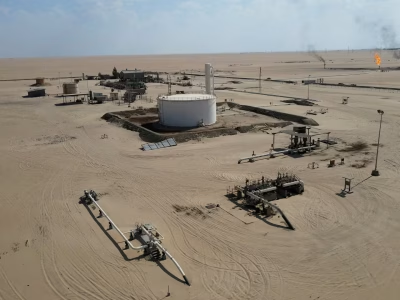
Libya, which ranks first in Africa in terms of oil reserves and fifth in natural gas reserves, stands as a strategic lever at the geographical and legal center of the maritime jurisdiction dispute between Turkey and Greece in the Eastern Mediterranean.
The Strategic Weight of the 2019 Maritime Memorandum
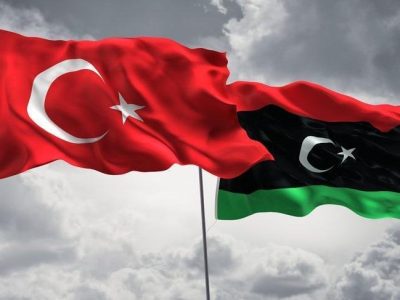
The 2019 Turkey–Libya Maritime Boundary Delimitation Memorandum of Understanding, which is one of the fundamental pillars of the “Blue Homeland” concept frequently advocated by military and strategic circles in Turkey, also provides a legal and geopolitical foundation for this concept.
This agreement redrew the map of the Eastern Mediterranean, blocking Greece’s thesis of extending its maritime jurisdiction southward based on Crete and opening a new strategic space for Ankara in the Western Mediterranean. Thus, Turkey prevented the reduction of its maritime jurisdiction through agreements between Greece and Egypt and gained a broader geopolitical maneuvering area via Libya.
By relying on this agreement, Turkey also sends strategic messages to the Greece–Cyprus–Israel trio through military deterrence, seismic exploration, and energy diplomacy.
The roots of the Eastern Mediterranean energy competition date back to the natural gas discoveries of Israel, Egypt, and the Republic of Cyprus in the early 2010s. These discoveries made the region visible in the global energy market, while the Eastern Mediterranean Gas Forum, established in Cairo in January 2019, emerged as a platform institutionalizing energy cooperation. Turkey’s exclusion from this structure deepened the bloc formation in energy diplomacy.
Tensions escalated further after the November 27, 2019 maritime boundary agreement between Turkey and Tripoli. In response, Greece signed its own maritime agreement with Egypt on August 6, 2020, reinforcing Athens’ strategy to expand its maritime claims and consolidate its legal standing.
While Turkey’s agreement with Libya counterbalanced Greece’s maximalist maritime claims south of Crete, Athens rejected the memorandum for disregarding Crete’s maritime jurisdiction. The European Union also declared the deal incompatible with international law, adding an international legal dimension to the dispute and transforming it into a multi-layered geopolitical issue.
Turkey’s Benghazi Initiative
In Libya’s dual political structure, Turkey’s dealings solely with the Tripoli-based administration had significantly weakened Ankara’s position. For this reason, secret talks with Benghazi starting in 2021 became visible with the visit of House of Representatives Speaker Aguila Saleh to Ankara in late 2023.
Negotiations—particularly those conducted through Saddam Haftar, son of Libyan National Army leader Khalifa Haftar—have pushed Turkey toward a more calibrated balancing policy between Tripoli and Benghazi.
Ankara’s primary objective is to secure approval from the Tobruk-based House of Representatives for the 2019 maritime agreement. During previous periods of tension, the House refused ratification, and in 2021 Libya’s Court of Appeal ruled the agreement invalid, rendering it controversial under Libyan domestic law.
Recent improvements in Ankara–Benghazi relations led to the formation in 2025 of a parliamentary committee tasked with reviewing the agreement. Ratification by the House would significantly reduce the domestic legal ambiguity surrounding the memorandum.
However, Egypt plays an important role in determining Benghazi’s stance. Haftar’s meetings in Cairo have raised the possibility that Egyptian President Abdel Fattah el-Sisi may have advised against recognizing the agreement.
Despite recent improvements in Turkey–Egypt relations, the two countries continue to compete for influence in Libya. Turkey’s rapprochement with Benghazi is aimed not so much at weakening Egypt’s position in Libya but at limiting Greece’s maneuvering space in the Eastern Mediterranean.
Recognizing this, Athens has intensified its diplomatic engagement with eastern Libyan authorities. Greek Foreign Minister Giorgos Gerapetritis’ visit to Benghazi on July 6–7, 2025, including talks with Haftar, reflects Greece’s concern that Turkey’s Libya policy represents a broader “containment from North Africa” strategy.
The Eastern Mediterranean Heats Up Again
After a period in which tensions gave way to relative calm, the situation in the Eastern Mediterranean became active again with a trilateral summit last December where the leaders of Israel, Cyprus, and Greece expressed their determination to deepen cooperation in energy, security, and defense.
The signing on February 16 of a hydrocarbon exploration agreement between Greece and the U.S.-based Chevron consortium for four blocks covering 47,000 square kilometers south of Crete and off the Peloponnese further escalated tensions.
Ankara argues that this agreement violates the 2019 Turkey–Libya memorandum. According to Turkey, the agreement constitutes a unilateral and unlawful activity that breaches the maritime jurisdiction areas notified by Libya to the United Nations.
However, the notable point is that the reaction came from sources within the Turkish Ministry of National Defense, while the Ministry of Foreign Affairs did not issue a similar institutional statement.
Likewise, Libya did not issue any official response. It can be interpreted that Ankara kept the tone of its reaction low in order to maintain diplomatic channels. It is also likely that Turkey restrained its response to avoid damaging the newly initiated normalization process with Greece.
A few days before the agreement was signed, on February 11, Greek Prime Minister Kyriakos Mitsotakis visited Ankara and attended the 6th meeting of the Turkey–Greece High-Level Cooperation Council with Recep Tayyip Erdoğan. The visit had been postponed several times over two years.
Libya as Turkey’s Gateway to Africa
With the Arab Spring, Turkey shifted its diplomacy from soft power to increasingly incorporating hard power instruments. Within this framework, Libya serves not only as an energy partner but also as a strategic gateway for Ankara’s broader Africa policy.
Energy Minister Alparslan Bayraktar’s declaration that 2026 will mark a milestone in Turkey–Libya energy cooperation underscores Ankara’s long-term perspective. For Turkey, Libya represents more than an investment destination; it is a strategic anchor in the Eastern Mediterranean and a geopolitical threshold capable of countering potential containment efforts.
For Libya, meanwhile, this renewed centrality presents both opportunity and responsibility. As external powers recalibrate their strategies, Libya’s energy wealth and geographic position once again place it at the heart of Mediterranean geopolitics, where economic decisions carry far-reaching strategic implications.
The ideas and concepts expressed in this piece are those of the author and do not necessarily reflect the positions of Libya Economic Review. If you would like to contribute to LER, contact us at younis@libyaeconomicreview.com.