Why Libya Remains Greece’s Hardest Challenge in the Eastern Mediterranean
For Athens, Libya is no longer a secondary file but a central front in its wider contest with Turkey across the Eastern Mediterranean.
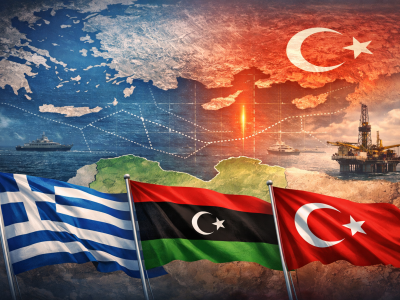
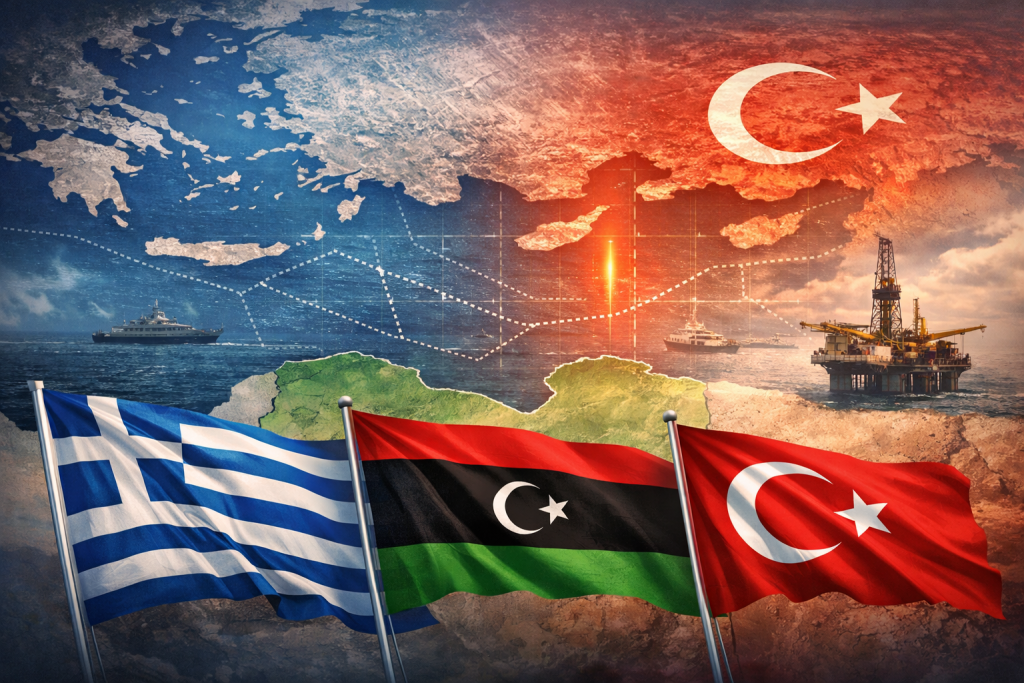
Greece, which has been engaged in a fierce competition and struggle for influence with Turkey over maritime jurisdiction and energy resources in the Eastern Mediterranean, undoubtedly faces its greatest obstacle in Libya. Despite possessing a significant geographical advantage over Turkey due to its islands scattered across the Eastern Mediterranean and Cyprus, and leaning on a global power like the European Union, Greece has been experiencing a profound state of hesitation following Ankara’s 2019 Libya move, which caused a major rupture in the region.
The Maritime Boundary Delimitation Memorandum signed between Turkey and Libya in 2019 has become more than just a diplomatic text; it has evolved into a “geopolitical barrier” drawn across the heart of the Eastern Mediterranean for Greece. While Greece sought to construct the region as its own internal sea by claiming full continental shelf rights for islands like Crete and Rhodes, the Ankara-Tripoli line cut through this thesis like a geographical pair of scissors.
Turkey did not merely gain a maritime border through Libya; it also fractured from the west the “East Mediterranean Gas Forum” (EMGF) encirclement that Greece had established with Egypt and Israel. At the current point, whenever Greece deploys seismic research vessels to the south of Crete, it confronts not only international law but also a Libyan will under the military and diplomatic umbrella of Turkey. This situation causes Greece’s strategy of “encirclement through islands” to collide with and shatter against the reality of Libya’s mainland coastline.
Another critical factor isolating Greece in this labyrinth is the difference in priorities within the European Union’s Libya agenda. Although Athens demands a harsh and sanction-oriented “European shield” from Brussels against the Turkey-Libya memorandum, the EU’s perspective on Libya remains largely limited to migration management and energy supply security.
Athens Seeks Balance Through American Companies
Athens has found only limited support within the EU for its claims over sovereign rights in the Eastern Mediterranean. France and Italy, both deeply involved in Libya’s energy sector, have their own interests to protect, while major companies such as ENI and Total have already established delicate arrangements with Tripoli. In response, Greece is increasingly looking to the United States for backing, seeking to draw in major American energy companies such as ExxonMobil and Chevron. From this perspective, the concessions granted to Chevron south of Crete on February 16 were far more than a technical energy decision. They added tension to an already sensitive area, where one side’s assertion of sovereignty is seen by the other as a challenge to its continental shelf. For Greece, Libya is no longer simply a neighboring state, but an unpredictable and influential diplomatic barrier shaping its wider contest with Turkey in the Eastern Mediterranean.
For Now, the Road from Athens to Tripoli Passes Through Ankara
Turkey’s strong influence in Tripoli has meant that, in practical terms, Greece must first manage its relationship with Ankara before it can meaningfully engage Libya. As a result, Athens’ Libya policy has become closely tied to its broader calculations vis à vis Turkey, rather than developing as a fully independent track.
Turkey’s involvement in Tripoli marked a major strategic turning point, one that Greece may not have fully anticipated at the time. Ankara played a decisive role in supporting the Tripoli based authorities during their confrontation with forces led by Khalifa Haftar, who had backing from several regional and international actors, including Russia, Egypt, the UAE, and France. At the time, given Turkey’s parallel tensions with Russia in Syria, some observers expected Moscow to place limits on Ankara’s room for maneuver in Libya.
The agreement that followed Turkey’s support for Tripoli came as a surprise to Athens. Greece responded by declaring Libya’s ambassador to Athens at the time, Mohamed Younis Menfi, now President of the Libyan Presidential Council, persona non grata, arguing that the contents of the agreement had not been disclosed to the Greek side. In an effort to protect its own position, Greece later sought to strengthen ties with eastern Libyan actors, hosting Khalifa Haftar in Athens the following year. During the same period, it also signed a maritime delimitation agreement with Egypt, a move widely seen as an attempt to counterbalance the Turkey Libya alignment.
Athens and Tripoli: One Step Forward, Two Steps Back
At the same time, Athens also sought to encourage the Tripoli authorities to reconsider their agreement with Turkey. In this context, Greek Prime Minister Kyriakos Mitsotakis visited Tripoli in 2021, both to reopen the Greek embassy, which had been closed since 2014, and to raise Greece’s concerns over the deal. However, the visit did not lead to a change in Tripoli’s position. A year later, relations between Athens and Tripoli faced another setback. Greek Foreign Minister Nikos Dendias traveled to Libya but did not disembark in Tripoli, citing objections over the reception arrangements, which included the presence of Libyan Foreign Minister Najla al Mangoush, who had signed the agreement with Turkey. He instead continued on to Benghazi. The episode added further tension to an already fragile relationship between the two sides. At the same time, Turkey’s expanding engagement across Libya has complicated Greece’s efforts to build influence, including in the east. Ankara has in recent years broadened and deepened its contacts with eastern Libyan actors, including through Khalifa Haftar’s son, Saddam Haftar, and has concluded a number of military and economic understandings with eastern Libya. The resumption of Turkish Airlines flights to Benghazi, Saddam Haftar’s three visits to Ankara, and visits by senior Turkish officials to Benghazi and Tobruk have all strengthened Turkey’s position in Libya’s evolving political landscape, narrowing the diplomatic space available to Athens.
Greece’s Greatest Trump Card Against Turkey: The European Union
Despite these challenges, Greece still retains several important sources of leverage in its broader competition with Turkey. The most significant of these is its membership in the European Union. The 2019 maritime agreement between Turkey and Libya has not been recognized by the EU, which argues that it affects the sovereign rights claimed by Greece and Cyprus. As a result, Greece remains in a position to influence aspects of Libya’s longer term economic engagement with the European Union and Western partners. At the same time, the issue has not been pushed to the forefront by Brussels. Given Libya’s importance as a migration route toward Europe, as well as Turkey’s broader strategic relevance in matters such as Ukraine and Iran, the European Union has so far shown limited appetite for opening a new front of tension with Ankara. Even so, the question could become more prominent in the period ahead.
Another strategic step taken by Athens has been its decision to open blocks south of Crete to major international energy companies such as ExxonMobil and Chevron. By drawing in large American firms, Greece appears to be widening the political and economic stakes in the area. Under such circumstances, any attempt by the Tripoli authorities to challenge activity in these zones could carry implications not only for Greek interests, but also for broader US energy considerations. Greece also benefits from the fact that Turkey’s position in Libya and Syria has been shaped to a considerable extent by shifting regional power dynamics and security realities. The evolution of US and Russian policies in ways that have, at times, created room for Ankara’s influence, together with the EU’s more limited foreign policy role in Africa and the Middle East, and Turkey’s active regional diplomacy under President Erdoğan, have all contributed to a stronger Turkish position relative to Greece in these theatres.
At the same time, the durability of this picture remains uncertain. Turkey is dealing with a range of economic and political pressures at home, while the regional environment has become even more volatile. The ongoing war involving Iran, which began on February 28 and has already drawn in the United States and Israel, has added a major new layer of uncertainty for Ankara. At the same time, Turkey’s relations with Israel, the unpredictability of US policy under President Trump, and the European Union’s evolving defense posture could all reshape the wider strategic landscape. Together, these factors may have significant implications for Turkey’s approach to both Libya and the Eastern Mediterranean
Domestic Stability in Libya Could Favor Athens
Libya’s internal fragmentation, weak coordination between institutions, economic vulnerability, and broader regional uncertainty have, for now, helped preserve Turkey’s strong influence in Tripoli. If Libya were to move toward greater internal cohesion and re-emerge with a more unified political identity, its decisions would likely become more independent, which could in turn make Ankara’s position more complex. At the same time, the regional environment has become even more unstable. The current war involving Iran, Israel, the United States and other Gulf countries, has already introduced a major new variable into the Eastern Mediterranean and Middle Eastern strategic landscape, while the Strait of Hormuz remains closed, disrupting a vital global energy corridor. These developments carry important consequences not only for Turkey and the Gulf states, but also for energy markets more broadly, with likely effects on oil and natural gas prices. In that sense, the course of the conflict and its economic repercussions will be among the key external factors shaping Libya’s future trajectory.
The ideas and concepts expressed in this piece are those of the author and do not necessarily reflect the positions of Libya Economic Review. If you would like to contribute to LER, contact us at younis@libyaeconomicreview.com.