Libya–Indonesia Vocational Training Cooperation Aims to Tackle Youth Unemployment and Oil Dependence
This week in Tripoli, Libya’s Technical and Vocational Education Minister Yakhlaf Al-Saifaw met with the Indonesian Embassy’s chargé d’affaires to explore a new cooperation in vocational training. According to ministry officials, the two sides discussed a memorandum of understanding that would include scholarships, revamped technical curricula and exchange programs designed to tie education more closely to employers’ needs and improve the skills of Libya’s national workforce. The outreach reflects Libya’s growing interest in breaking the long-standing gap between formal training and the job market.
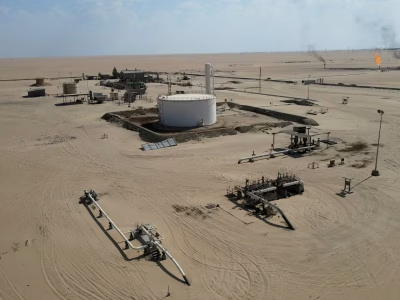
Libya’s economy remains overwhelmingly dependent on oil, and its labor market has been unable to keep up. By some estimates, hydrocarbons still account for well over 90 percent of government revenues, leaving the country highly vulnerable to oil price swings. In practice this has meant rapid growth in public-sector employment even as private-sector jobs stalled. Today, official reports put Libya’s overall unemployment near 19 percent, with youth joblessness around 50 percent. Many young Libyans, despite university degrees or technical diplomas, find themselves idle because of this mismatch in skills.
Libyan leaders and analysts have repeatedly highlighted this challenge. The Technical and Vocational Education Ministry itself emphasizes that its mission is to equip citizens with “in-demand skills” to boost employability and drive development. International efforts are already under way: for example, an EU-funded “Libya Al-Mahārāt – Land of Skills” program run by the British Council has been building leadership and management capacity in Libya’s vocational colleges and aligning them with industry needs. These kinds of initiatives recognize what Libyan commentators claim: education must match job opportunities. Even in 2025, oil and gas still dominate the economy but youth employment remains an important national focus. In practice, however, turning training into actual jobs will require steady planning, because Libya’s institutions have been weakened by years of conflict and divided governance. Libya’s political and economic system is still shaped by the collapse of central authority and years of competing power centres, which has eroded service delivery and left reforms fragile. Any vocational plan must operate in this complex environment.
Yet, against this backdrop, Libya has been actively seeking international partners for skills training. Earlier in 2025 the government had formal talks with several countries on education cooperation – notably a visit from Indonesia’s deputy foreign minister in October which produced pledges of new education MoUs, and even words of support on broader economic files. At the Jakarta session of the Libyan-Indonesian joint committee in December, officials on both sides agreed to strengthen links across trade, investment and education. These meetings provide confidence that technical and vocational education is already on the bilateral agenda: the joint committee explicitly listed “technical and vocational education” as a priority for cooperation. In parallel, Libya has seen visits from delegations of other partners. For example, last year Libya’s TVET minister met with Malaysian university representatives on student placements, and with China’s ambassador on equipping labs, underscoring that Libya is widening its search for know-how. The Indonesian talks fit into this broader diplomatic push: Libya is not focusing on one donor, but reaching out to any country willing to share vocational expertise.
Indonesia’s own agenda in this area helps explain its interest. Jakarta has recently launched ambitious programs to upgrade its workforce, including funding hundreds of millions of dollars of scholarships and training for its own high school and vocational graduates. The goal is to give Indonesians practical, internationally recognized skills and language training so they can compete for jobs worldwide. In that context, Indonesia sees work with Libya as an extension of its human-capital strategy. For example, Indonesia’s coordinating minister for human development has highlighted the need to align education and training with market demand and to produce skilled professionals who can represent the country’s quality workforce abroad. By partnering on technical training, Indonesia can both export its own expertise and help Libya groom the skilled technicians that Libya so urgently needs. Indeed, the countries have already built some educational ties: Libyan officials note that dozens of Libyan students are studying in Indonesian universities, while nearly 200 Indonesian students have been on scholarships to Libyan universities. That existing academic exchange may ease further collaboration on vocational subjects.
Bridging Policy and Practice
The Indonesian proposal outlined in Tripoli is still at the negotiation stage. A memorandum of understanding will have to be drafted and ratified by both governments. If it moves forward, likely steps would include placing Libyan trainees in Indonesian technical institutes or having Indonesian experts visit Libya to help update curricula. Success will depend on sustained commitment on both sides. For Libya, that means ensuring that trainees have clear career paths in the country’s economy. In the oil and gas sector, Libya already has active training institutes (for example Ajdabiya Petroleum Institute) and corporate graduate programs, but outside energy the picture is thinner. Analysts have warned that Libya must ensure its students see real job opportunities at home and abroad; otherwise even well-designed training can fail to relieve unemployment. In other words, linking “education with the labour market” as the Libyan statement puts it means more than agreements on paper – it means matching courses to companies’ actual needs.
On Indonesia’s side, working in Libya poses challenges too. Investment and trade between the two countries remain limited, and Libya’s business climate can be difficult. In the joint meetings of late 2025, both sides agreed to phase out visa requirements and signed a Chamber-of-Commerce MOU to stimulate investment. Those steps may facilitate sending teachers or sending Libyan students to Indonesian factories for internships. But Libyan instability, including rival authorities in Tripoli and the east, can complicate even straightforward deals. So far, however, Libya’s GNU government in Tripoli has been receptive to Indonesian overtures, and Indonesia’s embassy is willing to operate on a chargé-level basis rather than a full-time ambassador (at least until Libya stabilizes). These contacts suggest a cautious optimism that agreements on training could be implemented through existing channels.
In Libya’s broader strategy, the Indonesia talks complement other development goals. For years Libya has discussed diversifying its economy – from agriculture to light manufacturing and services – but progress has been slow. Building up technical institutes and linking them with business is one concrete way to shift this dynamic. As the Petroleum Gas Libya report noted, youths express strong interest in energy and engineering fields, and Libya has the raw intellectual capital; what’s needed is organized training and jobs. With more vocational training, Libya could raise technical productivity and begin to attract private firms beyond oil.
The meeting with Indonesia underlines a pragmatic tone in Tripoli’s policy: instead of grand alliances, officials are quietly trying to fix a core problem. Libya’s leaders recognize that adding value at home – training engineers rather than exporting only crude oil – requires international help, given Libya’s constrained resources. This small step toward Indonesia is emblematic of that approach. It is too early to predict concrete outcomes, but the policy rationale is clear. Libya cannot continue a rent-based economy forever. By strengthening its workforce through partnerships like this one, the country is taking aim at a long-standing mismatch. Empowering Libyan youth with vocational skills is central to moving beyond oil and creating a more stable economy. The Libyan delegation’s outreach to Indonesia suggests that, even in uncertain times, policymakers are pursuing the kinds of reforms seen as essential for future growth.