Libya Migrant Mass Grave Discovered Near Ajdabiya as Authorities Uncover Torture Network
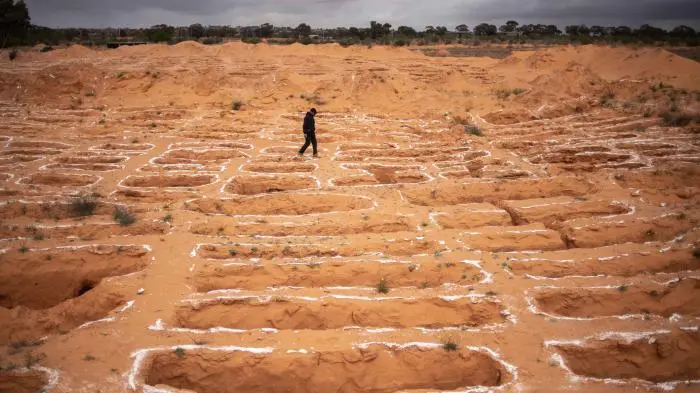
In mid-January 2026, Libyan authorities uncovered harrowing evidence of migrant abuse. A raid on a remote farm near the eastern town of Ajdabiya revealed a mass grave with at least 21 bodies of migrants – victims of a brutal trafficking ring. The migrants, mostly from sub-Saharan Africa, were found in a shallow pit and bore signs of torture. Only days later, security forces in the desert town of Al-Kufra freed over 200 migrants from a clandestine underground detention complex. One official source called the uncovered prison “one of the most serious crimes against humanity” discovered in the region. The freed captives – men, women and children – included a one-month-old infant. Local media circulated graphic images of Red Crescent volunteers gently placing the recovered bodies into black plastic bags. These incidents, so close in time and location, quickly drew Libyan and international attention to the country’s migrant crisis and its security vacuum.
Prosecutors Move Quickly
In Tripoli, the Public Prosecutor’s office announced it had identified a trafficker linked to both sites and referred him to court on charges of murder, torture and human trafficking. Local reports name the suspect as M.F.H. and say he headed the gang running the Al-Kufra prison and the Ajdabiya farm camp. Prosecutors say investigations led to the rescue of 195 detainees and the exhumation of the 21 bodies, and they have opened three criminal cases against the ringleader (for killings and trafficking) as a first step toward trial. DNA samples and autopsies have been collected from the remains, while authorities vow to hunt down any remaining gang members. In a public statement, the Attorney General reiterated that the defendant would face charges of “serious violations against migrants” and emphasized that the state was committed to dismantling the trafficking network.
International observers praised the swift action but warned it was only a beginning. The International Organization for Migration deployed emergency teams to aid the freed migrants, noting that the “horrific violations” in Ajdabiya and Al-Kufra underscore an urgent need to bolster protection mechanisms, fight human smuggling, and hold perpetrators to account. IOM reported that Libyan authorities closed the illegal Ajdabiya camp last week, freeing 195 migrants and recovering the 21 bodies from a nearby grave. In the separate Kufra raid, 221 migrants and refugees – including women, children and an infant – were released from three-meter-deep cells. Preliminary information indicates many had been held for months or years under deplorable conditions, and at least ten required urgent hospital care upon release. Humanitarian workers in Al-Kufra are now providing medical screening, clothing and support to the traumatized survivors. Rights groups have called for transparent investigations into how these detention sites operated “outside any legal framework.”
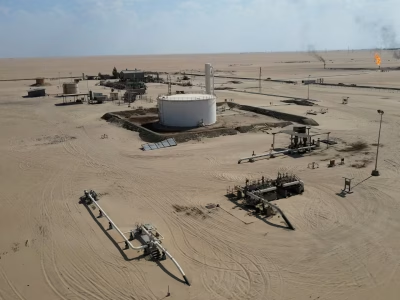
These episodes come amid growing scrutiny of Libya’s treatment of migrants. Just weeks before, in November 2025, Britain, Spain and others had urged Libya at the United Nations to shut down detention centers where torture, abuse and even killings have been routinely reported. The newly found sites appear to confirm those concerns. Libya’s biggest cities and ports have long been transit points for tens of thousands of migrants each year – drawn by the country’s oil-based economy and the hope of jobs, yet exposed to violent militias and smugglers in the desert interior.
A State Under Strain
The Ajdabiya and Al-Kufra cases highlight deep institutional weaknesses. Libya remains split between rival administrations – an eastern government backed by General Khalifa Haftar and a UN-recognized government in Tripoli – and neither exerts full control over the vast hinterland. The underground prison in Al-Kufra was uncovered by units aligned with the eastern authorities, for example, suggesting that coordination gaps may allow traffickers to exploit jurisdictional shadows. In effect, Libya’s unsteady post-2011 order has created a permissive environment for criminal networks. “With the collapse of a unified state, smugglers simply filled the gaps,” observes one analyst of migration in North Africa. The country’s oil wealth continues to draw desperate migrants from across Africa, but poor security and fragmented rule of law leave them vulnerable to extortion, torture and worse.
The public airing of these abuses now puts Libya’s fledgling institutions to the test. If prosecutors can successfully try the suspected trafficker, it will be a rare example of the state asserting its authority over militias. However, experts warn that true reform requires more than one trial. IOM and other agencies emphasize that preventing further tragedy will demand improved border monitoring, better data collection and stronger law enforcement overall. In other words, Libya’s leaders must decide whether to prioritize protecting migrant rights or simply tolerating a sordid status quo as long as the economy hums.
For ordinary Libyans, the discoveries underscore a painful paradox: the nation’s insistence on benefiting from African labor must square with basic human rights standards. The rescue of the Ajdabiya and Al-Kufra victims offers a sobering reminder that criminal networks will thrive wherever governance is weak. Observers will be watching closely to see if this moment drives genuine accountability. At the very least, the prosecutor’s urgent response signals that even amid political chaos, some parts of Libya’s justice system are willing to confront abuses. How the story ends may say as much about Libya’s future trajectory as the crimes themselves