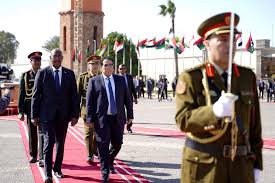
Libya Supreme Council of Presidencies Sparks East–West Political Rift
In Tripoli on Nov. 20, Libya’s internationally recognized authorities unveiled a new “Supreme Council of Presidencies,” combining the Presidential Council, the interim Government of National Unity (GNU), and the High Council of State. Tripoli’s leaders – including Presidential Council head Mohammed Menfi and GNU Prime Minister Abdul Hamid Dbeibah – said the council would coordinate national positions on key issues of security and economics. The body was announced as a means to unify decision-making on security, economic and political matters, and to “enhance institutional harmony” across Libya. But just two days later, Libya’s deep east–west divide reasserted itself.
On Nov. 22, the eastern-based government of Osama Hamad – appointed by the rival parliament in Benghazi and backed by Gen. Khalifa Haftar’s Libyan National Army – denounced the council as “constitutionally and legally null,” arguing that none of the existing institutions had authority to create it. It called on international partners to ignore any decisions of the council and warned that continued political stalemate and delays in elections could drive the eastern region to demand self-rule. These developments underscored the fragility of national consensus in Libya after more than a decade of conflict. International partners, including Italy, reaffirmed their support for a Libyan-led political process and stability.
East-West Rift Deepens
Libya has effectively operated under two competing administrations since 2014. In theory, the UN-backed GNU in Tripoli is meant to govern nationwide, but much of the east answers to a parallel Benghazi administration chosen by the eastern-based parliament and aligned with Haftar’s forces. Each side has developed its own institutions and budgets. Tripoli’s leaders argued that the new Supreme Council was a technical solution aimed at bridging these divisions. In practice, separate administrations mean parallel budgets: public spending in the east has often run independently of Tripoli’s allocations. In Benghazi, officials accused the council of undermining Libya’s fragile institutions, saying it “obstructs the electoral process and creates an unconstitutional crisis”. For now, neither side is retreating from its position, and questions remain about which constitution or legislature ultimately governs national decisions.
In the meantime, Tripoli’s government has pressed ahead on economic reforms. Last week a Libyan delegation flew to Washington to meet with U.S. Treasury officials and discuss cooperation on public finance. The Libyan team highlighted steps such as establishing a unified treasury account for civil-service salaries and cracking down on unrecorded spending – measures intended to strengthen fiscal discipline. U.S. officials emphasized that only a single, unified national budget can restore stability and confidence in Libya’s institutions. They also stressed that any use of Libya’s frozen foreign assets abroad would have to comply with U.S. sanctions rules. Both sides agreed to maintain direct and regular coordination to support Libya’s reform agenda, reflecting a shared interest in economic stabilization even as political consensus remains elusive. For Tripoli’s government, these international meetings serve to highlight its reform agenda and signal global confidence in its management. But the contrast with the eastern leadership’s rejection highlights how fragile Libya’s institutions remain.
Economic Reform amid Political Gridlock
Observers warn that Libya’s economic recovery is still handicapped by its political divisions. An IMF mission that visited in November reported that “long-standing political divisions” have prevented adoption of a unified budget, resulting in “continued unrestrained spending”. Those uncoordinated budgets have kept Libya’s fiscal and external deficits very large. The IMF noted that higher oil output has helped growth, but lower oil prices and unchecked spending mean that budget and current-account shortfalls will persist. Staff recommended that Libya agree on a realistic spending envelope for wages and investment that aligns with available revenues.
The result is effectively two overlapping financial systems – one in the west, one in the east – which complicate basic economic management. Investors and aid agencies now face uncertainty over which administration holds authority over contracts and revenues. Libya’s economic lifeline – mainly oil – cannot fully revive without clear institutions; if state bodies veto deals or refuse to recognize revenues, foreign investors will stay on the sidelines. In effect, every major contract or policy decision becomes a potential flashpoint in the east–west conflict. Many Libyans and their international partners hope this polarizing episode might ultimately force a compromise, but for now each policy and investment is scrutinized through the prism of political rivalry.
Against this backdrop, the aborted Supreme Council carries heavy symbolism. It was intended as a stopgap – not a permanent body, but a forum where Tripoli’s leaders could make unified decisions on key issues while awaiting elections. Its rejection by the east suggests that even carefully crafted technocratic fixes may founder on political distrust. For now, Libya’s economy and institutions will continue to bear the costs of divided leadership. Western officials emphasize that unified governance is crucial for any successful elections and fiscal stabilization, but each week brings new evidence of the split. Absent agreement, Libya faces a stark choice: fully unify under one national government, or cement a bifurcated state. The international community continues to press for elections, but with each new body that fails and each veto that follows, many fear the country’s economy will lurch from crisis to crisis under two parallel administrations.