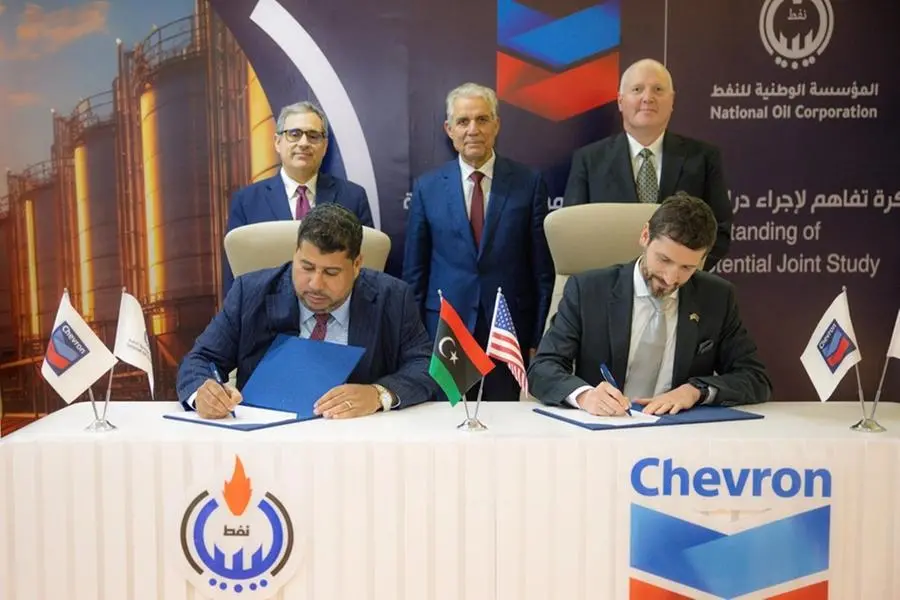
Libya has taken a major step toward expanding its energy frontier after the National Oil Corporation (NOC) signed a strategic agreement with Chevron to assess the country’s shale oil and gas potential. The deal marks a shift in Libya’s upstream strategy as Tripoli looks beyond conventional reserves and targets unconventional resources to strengthen long-term output and attract global investment.
Under the agreement, both sides will conduct a joint technical study across key sedimentary basins, including Sirte, Murzuq, and Ghadames. Technical teams will analyze existing geological data and evaluate the commercial viability of shale extraction.
Preliminary estimates suggest Libya could hold around 123 trillion cubic feet of shale gas and up to 18 billion barrels of shale oil. These figures, if confirmed, would place Libya among the most promising unconventional energy frontiers in North Africa.
A Strategic Pivot Toward Unconventional Resources
Libya has long relied on conventional oil production, with the Sirte Basin alone accounting for the vast majority of its output. However, the NOC now aims to diversify its resource base and extend the lifespan of its hydrocarbon sector.
This agreement signals a deliberate pivot toward shale development. Unlike traditional reservoirs, shale resources require advanced extraction techniques and significant upfront investment. By partnering with Chevron, Libya gains access to technical expertise, capital, and global operational experience. The move also aligns with broader plans to increase production capacity. Libya targets output of up to 1.6 million barrels per day in the near term, with longer-term ambitions reaching 2 million barrels per day by the end of the decade.
At the same time, officials continue to push for increased gas production to supply both domestic demand and export markets, particularly in Europe.
Chevron Deepens Its Return to Libya
The shale agreement builds on Chevron’s growing footprint in Libya following its re-entry into the country earlier in 2026. The US energy major secured exploration acreage in Libya’s first licensing round in nearly two decades, marking a significant return after years of absence.
Chevron has already signed multiple memoranda of understanding with the NOC this year, covering both onshore and offshore opportunities. The company’s strategy focuses on high-potential basins with existing infrastructure and strong geological prospects. This latest deal expands Chevron’s role from conventional exploration into unconventional resource assessment, positioning the company as a key long-term partner in Libya’s energy sector.
The agreement also reflects renewed confidence among international oil companies as Libya stabilizes its operating environment and reopens its upstream sector to foreign investment.
A Broader Wave of Energy Investment
The NOC–Chevron agreement comes amid a wider resurgence of global interest in Libya’s oil and gas sector.
Major international players, including Eni, Repsol, and QatarEnergy, have secured exploration blocks in recent months. This wave of investment follows Libya’s first bid round since 2007 and signals a turning point for the country’s energy industry.
At the same time, Libya has signed multi-billion-dollar deals with companies such as TotalEnergies and ConocoPhillips to expand production capacity and modernize infrastructure.
The government continues to position the energy sector as a cornerstone of economic recovery, with upstream development expected to drive revenue growth, job creation, and foreign direct investment.
Unlocking Long-Term Energy Potential
The success of the shale assessment will depend on technical feasibility, regulatory clarity, and sustained political stability.
Shale development requires complex infrastructure, water resources, and cost-intensive drilling techniques. Libya will need to address these challenges while ensuring that investment conditions remain attractive to international partners. However, the potential upside remains significant. If commercially viable, shale resources could transform Libya’s energy outlook, extend reserve life, and strengthen its role in global energy markets.
For the NOC, the agreement with Chevron represents more than a technical study. It signals a long-term strategy to reposition Libya as a diversified energy producer capable of competing in both conventional and unconventional markets.
As global energy demand evolves, Libya is moving to secure its place in the next phase of the industry—one that increasingly values scale, flexibility, and resource diversity.