Can Libya turn sunlight into sovereignty?
Libya’s vast solar potential offers an opportunity to rethink the country’s energy future. As climate change increases the risks facing vulnerable communities and reliance on hydrocarbons leaves its electricity system exposed, renewable energy could provide a more resilient and domestically controlled alternative for Libya. With international oil companies returning to exploit Libya’s reserves, will Libya finally control its own energy future, or will its resources remain another prize for foreign powers to compete over?
The apocalyptic images from Nepal are difficult to look at. Entire communities have been swallowed by water and mud. For Libyans, there is an uncomfortable familiarity with this devastation. Three years ago, Derna suffered its own catastrophe, when Storm Daniel materialized into Libya’s worst natural disaster.
The lesson from both disasters is difficult to escape. Nature can be unforgiving, but the consequences of catastrophe are shaped by what societies build, what they neglect and who controls the resources needed to protect the most vulnerable in society.
For Libya, that question is becoming increasingly important. Its oil wealth has long placed the country at the centre of foreign strategic interests, while its own population continues to endure an electricity system plagued by blackouts, ageing infrastructure and attacks on critical facilities.
Libya possesses some of the highest solar-energy potential in the Mediterranean. Yet its electricity system remains overwhelmingly dependent on hydrocarbons, while the hydrocarbon sector itself continues to attract major international energy companies.
That makes the development of renewable energy more than a question of climate policy. For Libya it is central to the question of who controls the country’s national resources and therefore the nation’s future.
Foreign energy, domestic vulnerability
The contrast is particularly striking as international energy companies deepen their presence in Libya. The return of Chevron, alongside the expanded presence of Eni, Repsol and other international energy companies, following Libya’s first licensing round in nearly two decades last year, underscores the continued importance of foreign companies to Libya’s hydrocarbons sector.
If Libya is to increase its hydrocarbon output, then it will ultimately have to rely on foreign capital and expertise in the short term. However, the continued dependence on external companies to develop Libya’s national resources raises questions over whether the country’s vast energy wealth can ultimately translate into national energy security.
That vulnerability has been starkly demonstrated by the rolling blackouts that have affected Tripoli and western Libya in recent months. Prolonged outages have been driven by a combination of ageing infrastructure, high demand and disruptions to gas supplies, while attacks on energy infrastructure have further exposed the fragility of Libya’s over reliance on hydrocarbons for its energy demands. In August, a drone strike destroyed a power substation in Zawiya, cutting electricity to large parts of the surrounding area, while repeated attacks on oil and gas facilities threatened further disruption to power generation.
The crisis illustrates that energy security is not simply a question of how many barrels of oil can be extracted by Chevron, but whether Libya can protect and reliably distribute that energy to its population.
A green transition on Libya’s terms
Renewable sources such as solar, wind, or tidal power could offer the country an opportunity to exploit a resource it does not have to extract, export or share with foreign oil companies. Yet the capital, technology and expertise required to build large-scale renewable infrastructure will still bring international companies into the heart of Libya’s energy sector.
TotalEnergies, one of the largest foreign companies in the country’s oil and gas sector, is a major player in the development of the 500-megawatt Al-Sadada solar project, planned as Libya’s first large-scale solar installation. The project is being developed alongside the General Electricity Company of Libya and the Renewable Energy Authority of Libya.
The project illustrates the crossroads Libya faces as it pursues a green energy transition. The question is not simply whether Libya can go green. It is whether it can do so on its own terms.
There are already signs that a domestic renewable-energy sector is taking shape. The Renewable Energy Holding Company, established in 2017, is a Libyan state-owned enterprise wholly owned by the Renewable Energy Authority. Its activities include the design and implementation of renewable-energy projects, technical studies, procurement and infrastructure contracting.
There are also several privately owned Libyan companies operating in the renewable-energy sector, including SOLA Energy, Libyan Solar System Company, Al Qema Renewable Energy, Lighting Group and Ghibli Energy, which focus on solar installation, engineering, consultancy and the development of utility-scale projects while building local expertise.
The importance here is that a green transition in Libya does not necessarily mean replacing one form of foreign dependence with another. If Libya continues to develop its own domestic companies and technical workforce, solar power could become an instrument of economic and energy independence as well as de carbonisation.
This could also create a wider economic opportunity. Developing a domestic renewable sector would require engineers, technicians, construction companies, maintenance specialists and local suppliers. Over time, that could allow more of the value created by Libya’s energy transition to remain inside the country rather than flowing primarily to foreign contractors and technology providers.
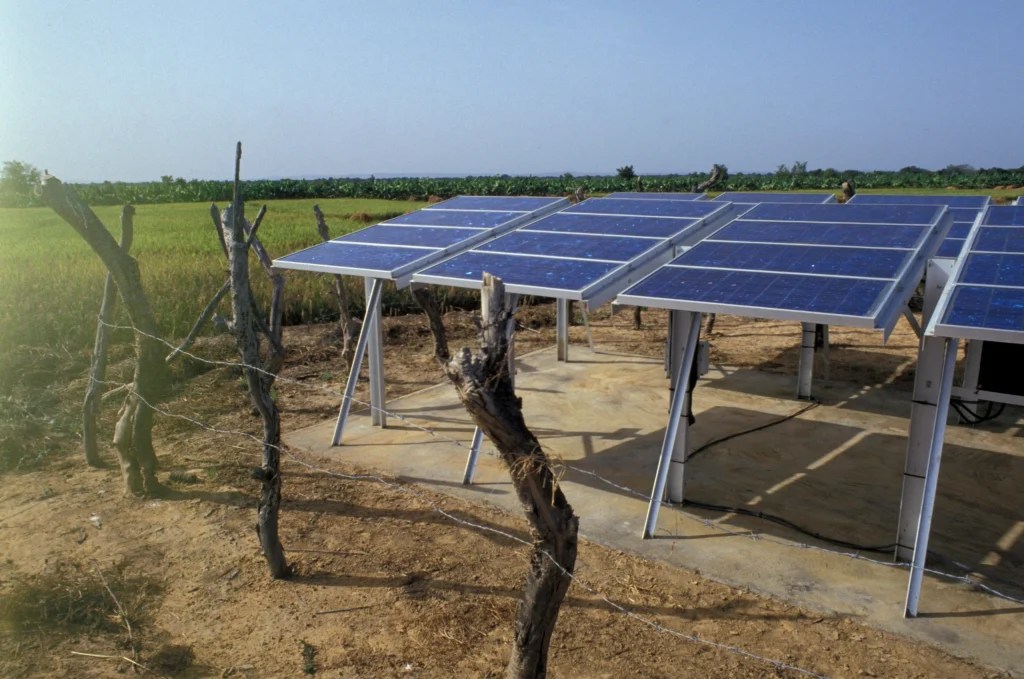
The potential is enormous. Libya’s vast desert territory receives abundant sunlight, while the country has already begun establishing the infrastructure needed to measure and develop its renewable resources. The Renewable Energy Authority has also pursued projects bringing solar power to remote communities. But the scale of the challenge should not be underestimated.
Libya’s oil industry remains the foundation of its economy and the main source of government revenue. Its electricity network has long struggled with shortages and instability, while political fragmentation has made nationwide infrastructure development difficult while fuel smuggling runs rife.
A green transition would therefore require more than solar panels. It would require a functioning national grid, investment, regulatory certainty and institutions capable of maintaining vulnerable infrastructure, which is where climate change makes the question increasingly urgent.
Derna’s warning
The images emerging from Nepal in recent weeks have offered a devastating glimpse of what a rapidly changing climate can look like. A glacier collapse on August 26 triggered catastrophic flooding across the Nepal-Tibet border region, destroying villages and critical infrastructure. More than 1,000 people have been killed, with thousands more missing, while hydro power infrastructure has also been badly damaged.
For Libya, a more familiar warning came three years earlier. In September 2023, Storm Daniel brought catastrophic rainfall to northeastern Libya, causing the collapse of two dams above Derna and sending a wall of water through the city. Thousands were killed and large parts of Derna were destroyed.
The 2023 World Weather Attribution study found that human-induced climate change made rainfall of the magnitude experienced in north-eastern Libya up to 50 times more likely and up to 50% more intense than in a pre-industrial climate.
However, climate change alone did not produce this catastrophe. The consequences were amplified by exposure, vulnerability and infrastructure failures, such as the collapse of the dams.
That distinction is important. Climate change creates greater risks, but effective governance and disaster preparedness determines how devastating those risks become. Derna exposed what happens when extreme weather meets deteriorating infrastructure and institutional weakness. For Libya, the lesson from Derna should extend beyond emissions.
A country sitting on vast oil reserves might understandably continue exploiting them. But in a new world with an unstable climate, investing in resilient infrastructure and diversifying the energy system becomes a matter of national security.
Renewable energy cannot prevent another Derna. Nor would abandoning oil overnight make Libya safer. However, a diversified energy sector could reduce the country’s dependence on hydrocarbons while allowing investment in modern electricity infrastructure, decentralized generation and more resilient power networks.
More importantly, it could give Libya a different relationship with its own energy resources.
Beyond oil, towards sovereignty
Oil has made Libya strategically important to foreign powers for decades. Its reserves have attracted international companies, the strategic interest of the US and other governments, while control over the country’s energy wealth has repeatedly intersected with its political divisions.
Solar power offers a different proposition. The sun cannot be blockaded, embargoed or depleted in the same way as an oil field. It is distributed across Libya’s territory rather than concentrated in a handful of strategically important geographical zones. And once the infrastructure is built, the underlying energy source does not have to be extracted from the ground, processed in foreign refineries and sold on international markets.
That does not make renewable energy inherently sovereign. A foreign company can own a solar farm just as it can operate an oil field. The difference is that Libya has the opportunity to ensure that the technology, skills, infrastructure and companies associated with renewable energy become increasingly Libyan-owned.
The existence of the Renewable Energy Holding Company and Libya’s private sector enterprises suggests that foundation already exists. The challenge is whether Libya’s fragmented political system can develop it into a genuinely national industry. That is perhaps the most important question surrounding the country’s green transition.
As international energy companies return to Libya, the country is once again being asked to consider how its natural resources can generate wealth. But Libya does not have to choose between exploiting its oil and embracing renewable energy.
It can use the wealth and expertise generated by its existing hydrocarbon sector to build something beyond it. The opportunity is not simply to replace oil with solar, it is to build an energy sector that Libya controls. Its hydrocarbons will remain essential to the economy for years to come, and foreign investment will continue to play a role in developing them. But that should not mean accepting a future in which Libya’s energy sector is shaped solely by those with the capital to extract its resources.
The country’s renewable potential offers a different possibility. Solar power cannot solve Libya’s political fragmentation or prevent another Derna, but a stronger domestic renewable industry could diversify the energy system, strengthen resilience, create opportunities for Libyan companies and workers and give them a greater stake in the country’s future.