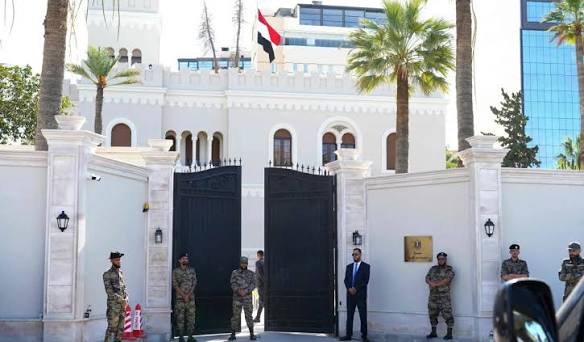
Egypt has reopened its embassy in Tripoli after 12 years, marking an important shift in its diplomatic engagement with Libya. The move brings Cairo closer to the Government of National Unity (GNU) in western Libya and creates an opportunity to strengthen economic ties, expand energy cooperation and improve access to one of North Africa’s largest markets.
Egyptian Foreign Minister Badr Abdelatty reopened the embassy on November 7, ending a diplomatic absence that began in 2014 as fighting intensified across Libya. The reopening also marked the first bilateral visit by an Egyptian foreign minister to Tripoli since 2011, according to Ahram Online.
The decision carries political significance. Egypt has historically maintained close relations with eastern Libya, particularly with military commander Khalifa Haftar, who controls much of the country’s east alongside the House of Representatives and the government based in Benghazi. Cairo’s renewed diplomatic presence in Tripoli signals a more direct approach to dealing with both sides of Libya’s political divide.
Egypt seeks a stronger position in Libya
Egypt’s policy towards Libya has long reflected its security interests along their shared border. Cairo has supported stability in eastern Libya and viewed the conflict through the risks it poses to Egyptian national security, including cross-border militancy, arms trafficking and irregular migration.
However, maintaining relations with eastern authorities alone limits Egypt’s ability to engage with institutions and economic decision-makers in Tripoli. The GNU controls the capital and several key state institutions, including ministries responsible for economic policy, energy and public services.
Reopening the embassy gives Cairo a permanent diplomatic channel to the western administration and a stronger platform to pursue its interests across the country. It does not necessarily signal a break with Haftar or a change in Egypt’s established security priorities. Rather, it reflects the practical need to maintain working relationships with both centres of power.
For Libya, the development offers an opportunity to deepen relations with an important neighbouring country without requiring a political settlement between rival administrations first.
Energy, trade and investment offer the biggest opportunities
The economic implications could prove more significant than the diplomatic symbolism. Egypt and Libya have complementary economic interests, particularly in energy, infrastructure, construction and labour.
Egyptian companies have previously played a role in Libya’s reconstruction efforts, while Egyptian workers represent an important source of labour for Libyan businesses and construction projects. A stronger diplomatic presence could help facilitate business visits, commercial agreements and the movement of workers between the two countries.
Energy cooperation also offers considerable potential. Discussions during Abdelatty’s visit included gas pipeline connections, refining Libyan crude in Egypt for re-export, rehabilitating Libyan refineries and electricity interconnection, according to Madar.
These areas align with Libya’s need to improve domestic energy infrastructure and expand its gas sector. Egypt, meanwhile, has established refining capacity, energy infrastructure and experience in managing large-scale projects. Greater cooperation could create opportunities for Egyptian contractors and energy companies while helping Libya address weaknesses in its domestic refining and electricity systems.
The two countries also signed a memorandum of understanding on health cooperation, highlighting the potential to expand bilateral ties beyond energy and construction.
For Libya, stronger economic relations with Egypt could support reconstruction, improve access to technical expertise and attract additional regional investment. Egypt also stands to benefit from access to the Libyan market, particularly as Tripoli seeks to advance infrastructure and development projects.
The embassy reopening, however, does not guarantee that these opportunities will translate into investment. Progress will depend on political stability, clear commercial agreements and the ability of Libyan institutions to implement projects.
Egypt’s return to Tripoli is therefore more than a diplomatic gesture. It reflects Cairo’s recognition that its interests in Libya require engagement across the country’s political divide. Whether this produces a lasting expansion in trade and investment will depend on what follows the reopening, particularly in energy, infrastructure and economic cooperation.