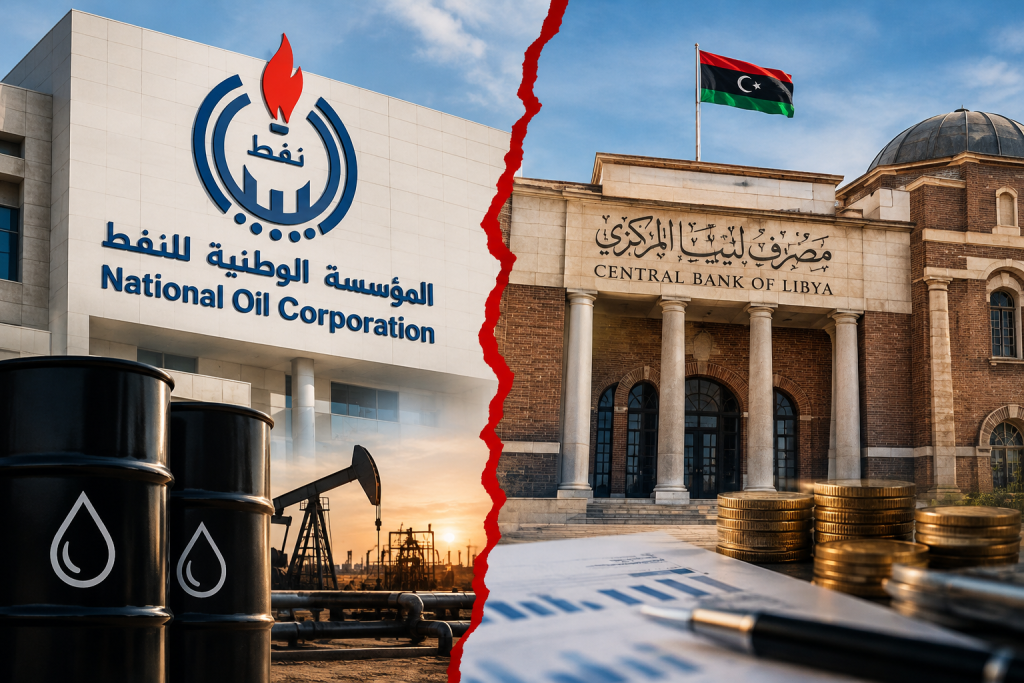
Libya’s National Oil Corporation (NOC) has called for an independent investigation into the Central Bank of Libya’s reporting of oil revenue, raising questions about financial disclosure and coordination between two of the country’s most important economic institutions.
In a statement on October 15, the NOC said $1.23 billion had been transferred to the sovereign account at the Libyan Foreign Bank by October 13. The figure differs from the $361 million in oil revenue reported by the Central Bank for October 1–14. The NOC argues that the Central Bank’s figure does not reflect the full financial flows associated with oil revenue. The corporation’s statement calls on the Attorney General’s Office to investigate the figures, the transfer mechanism and the reasons for the difference.
The discrepancy concerns how Libya records oil income and accounts for the costs of importing fuel. It does not, on its own, establish that funds are missing or that either institution has acted improperly.
NOC challenges Central Bank revenue figures
The NOC says the transfers follow a financial mechanism approved under Cabinet Decision No. 525 of 2026. Under this arrangement, the Libyan Foreign Bank deducts amounts needed to cover fuel-import costs through letters of credit before transferring the remaining balance to the Central Bank.
The corporation argues that reporting the net amount without explaining the wider flow of funds gives the public an incomplete picture. It also says it informed the Central Bank governor on October 8 that transfers had already exceeded $700 million.
The NOC separately alleges that the Central Bank has withheld government-approved budget allocations, limiting the corporation’s ability to meet financial commitments and carry out maintenance and development projects. The Central Bank’s position on these specific allegations was not included in the material reviewed for this article.
The dispute highlights the importance of distinguishing between gross transfers, deductions for fuel supplies and the net revenue received by the Central Bank. These figures can differ because they measure different stages of the same financial process. A transparent reconciliation would help establish how the reported amounts relate to one another.
An independent review could clarify the figures and determine whether the institutions followed the approved procedures. Publishing the findings would also give the public a clearer account of how oil income moves through the financial system.
Why Libya needs stronger financial oversight
The disagreement comes as Libya seeks greater coordination in public spending and economic management. In April, the United Nations Support Mission in Libya welcomed a unified spending framework for 2026, while stressing the need for effective implementation, stronger oversight and transparent reporting of oil revenue.
The framework offers an opportunity to improve coordination between the institutions responsible for collecting revenue, managing public finances and funding essential services. But agreements alone cannot deliver these results. They require consistent reporting, clear responsibilities and independent oversight.
Libya’s dependence on oil makes these safeguards particularly important. Oil income finances much of the state’s spending, while fuel imports and subsidies place substantial demands on public resources. Without clear accounts of both revenue and expenditure, it becomes harder to assess the state’s financial position, plan investment and ensure that public money reaches its intended purposes.
The current dispute should therefore be viewed as an opportunity to strengthen financial reporting rather than simply as a disagreement between institutions. Regular reconciliation of oil receipts, fuel-import costs and transfers to the Central Bank would help prevent similar confusion. Publishing consistent figures and making the underlying accounting process easier to understand would also strengthen public confidence.
These steps matter as Libya works towards greater institutional unity. Political agreements will have limited economic value unless the institutions supporting them can operate under common standards and provide reliable information about public finances.
Reform does not need to wait for a final political settlement. The NOC, the Central Bank and the relevant oversight bodies can improve disclosure, clarify their respective responsibilities and strengthen coordination within the existing system.
The immediate priority is to establish the facts behind the revenue figures. The longer-term objective is to ensure that Libya’s economic institutions can manage the country’s oil wealth transparently and consistently, providing a stronger foundation for a more unified state.