
Libya’s Oil Revenue Gap: How $18.46 Billion in Exports Became $11.16 Billion at the Central Bank
The headline difference is real, but it is not one unexplained pot of missing money. Libya’s published figures show two separate gaps: one between exports and cash collection, and another between collection and transfer to the Central Bank.
Between 1 January and 31 July 2026, Libya produced approximately 287.9 million barrels of crude oil.
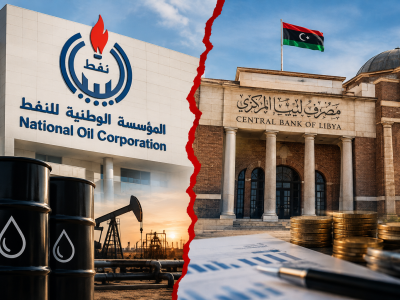
During the same period, the Libyan Audit Bureau recorded around 193.4 million barrels as exports from the National Oil Corporation’s share. The total value of oil, condensate and petroleum-product exports reached $18.463 billion. But only $15.789 billion was reported as collected in the oil-revenue account at the Libyan Foreign Bank. Just $11.160 billion was transferred to the Central Bank of Libya.
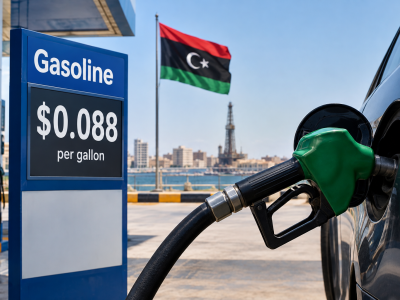
Libya also spent approximately $6.122 billion on fuel imports during those seven months. At first glance, the numbers raise an obvious question: How did $18.46 billion in exports become just $11.16 billion at the Central Bank?
The answer is more complicated than saying $7.3 billion simply disappeared.
The figures point to two separate gaps: $2.674 billion between recorded export value and cash collected, followed by $4.629 billion retained to finance imported fuel.
The breakdown
The Audit Bureau’s figures can be reconstructed as follows:
- $18.463bn — recorded export value
- $2.674bn — settlements and amounts not yet collected
- $15.789bn — collected at the Libyan Foreign Bank
- $4.629bn — revenue reserved for imported fuel
- $11.160bn — transferred to the Central Bank
The second part of the calculation is straightforward:
$15.789bn collected − $4.629bn reserved for fuel = $11.160bn transferred to the Central Bank.
In other words, for every $100 of recorded oil-export value, around $85.52 had been collected. Of the original $100, approximately $25.07 was then retained to finance fuel imports, leaving $60.45 transferred to the Central Bank.
The arithmetic does not support the simplistic claim that the entire $7.3 billion was missing or stolen.
But an arithmetic reconciliation does not prove that every transaction was timely, economical or properly governed.
The published figures explain the broad destination of the money. They do not provide enough transaction-level information to independently verify every step.
The first gap
The first gap is the $2.674 billion between the $18.463 billion recorded value of exports and the $15.789 billion collected at the Libyan Foreign Bank.
That represents around 14.5% of recorded exports.
According to the Audit Bureau, the amount includes a mixture of settlements, outstanding amounts, reserved values, fuel-related obligations and transactions involving foreign and domestic companies.
That means the entire $2.674 billion should not automatically be treated as overdue receivables.
The problem is that these categories are grouped together rather than presented through a detailed ageing schedule.
A proper reconciliation would show how much was:
- Not yet due on 31 July
- Already due but unpaid
- Temporarily blocked or reserved
- Subject to pricing adjustments
- Disputed
- Linked to fuel-related settlements
Without that breakdown, it is difficult to distinguish a normal collection delay from a genuine overdue balance or an amount at risk of non-recovery.
Timing matters
Oil revenues also move through several stages.
The date a cargo is lifted, the invoice date, the contractual payment date, the date the buyer pays the Libyan Foreign Bank and the date funds reach the Central Bank can all fall in different months.
That makes it important to distinguish between exports, cash collections and sovereign transfers.
They are not interchangeable measures of revenue.
The fuel deduction
The second gap is clearer.
Of the $15.789 billion collected by the Libyan Foreign Bank, approximately $4.629 billion was reserved for imported fuel.
That was equal to 29.3% of collected oil revenue and 25.1% of the gross recorded export value. As a result, only $11.160 billion was transferred directly to the Central Bank.
This is the key point behind the headline.
A significant share of Libya’s oil-generated foreign exchange did not reach the Central Bank as an unrestricted transfer because it was used upstream to finance the country’s fuel-import system.
A February 2026 example shows how the mechanism works.
The NOC reported that the Libyan Foreign Bank collected approximately $1.001 billion that month from crude sales made in January. Of that amount, $295.7 million was reserved for fuel, while $705.4 million was transferred to the Central Bank.
The NOC separately reported approximately $768.5 million in in-kind guarantees allocated to settle January fuel costs.
The example highlights why Libya’s oil accounts cannot be understood through one headline figure. Sales, collections, fuel settlements and Central Bank transfers can all occur on different timelines.
The fuel bill
The Audit Bureau reported that Libya imported approximately 6.107 million tonnes of fuel during the first seven months of 2026, costing $6.122 billion.
The imports arrived through 207 cargoes:
- 105 gasoline shipments
- 95 diesel shipments
- 7 gasoline-improver shipments
The total fuel bill was equivalent to 33.2% of Libya’s gross recorded oil-export value during the period.
But there is another gap.
The $6.122 billion fuel bill was $1.493 billion higher than the $4.629 billion deducted from collected oil revenues.
That difference could reflect timing, previous settlements, unpaid fuel obligations, letters of credit, guarantees or amounts included within the $2.674 billion in settlements and outstanding balances.
The public data, however, does not provide a consolidated cash-flow statement showing exactly how that remaining $1.493 billion was financed or scheduled for payment.
This is where the current disclosure falls short of a complete reconciliation.
The royalty question
The Audit Bureau also reported that the Central Bank received approximately $2.078 billion in oil royalties or related state entitlements.
Adding this to the $11.160 billion transferred from collected export proceeds gives total oil-related receipts at the Central Bank of approximately $13.238 billion.
But these categories should not simply be combined.
Royalties and taxes paid by oil operators are economically and legally different from proceeds generated through the sale of the state’s crude-oil share.
One is a fiscal payment. The other is a commercial sales receipt.
A transparent statement should therefore show them separately:
- Gross oil and product sales
- Cash collected
- Royalties and taxes
- Fuel-import costs and deductions
- Outstanding receivables
- Transfers to the Central Bank
Combining these categories into one “oil revenue” figure may increase the headline total, but it makes the underlying transactions harder to follow.
More data, less clarity
Libya now publishes more oil-sector data than it did in previous years. That is a positive development.
But the institutions publishing the numbers do not always use the same definitions, timing or classifications.
Differences have appeared between NOC and Audit Bureau figures covering the same broad period, particularly around production and the classification of the NOC or state share.
The deeper problem is therefore not necessarily that one institution’s dataset is wrong.
It is that terms such as “Libya’s share,” “NOC share,” “production,” “exports,” “achieved price,” “revenue” and “collection” are not accompanied by a common public data dictionary.
As of 24 August 2026, the Central Bank’s public revenue-and-expenditure archive also does not provide a regular monthly statement covering the same seven-month period that allows the public to fully reconcile the Audit Bureau’s oil figures with government revenue, foreign-exchange use and public spending.
Each institution publishes part of the story, but no single public statement connects the entire chain.
Why fuel matters
This is not simply an accounting issue.
Oil dominates Libya’s economy. According to the World Bank, hydrocarbons accounted for an estimated 65% of GDP, 93% of exports and 72% of government revenue in 2024.
How oil proceeds are collected, deducted and transferred therefore directly affects government spending, foreign-currency availability, international reserves and exchange-rate stability.
The IMF also warned in April 2026 that Libya’s fiscal path was unsustainable. It estimated that energy subsidies were around 20% of GDP, while the public wage bill stood at roughly 30%.
Against that backdrop, using almost one-third of collected oil revenue to finance imported fuel is not simply a technical settlement mechanism.
It is one of Libya’s largest fiscal and foreign-exchange decisions.
Yet it takes place before the remaining money is transferred to the Central Bank and before the full cost is presented transparently as a conventional budget expenditure.
What should change?
Libya does not need to publish commercially sensitive information in real time to improve transparency. It needs a standard reporting chain that can be independently reconciled. Every month, Libya should publish an oil-revenue waterfall covering:
- Production and the state’s share
- Lifted quantities
- Invoiced value
- Amounts due
- Cash collected at the Libyan Foreign Bank
- Fuel deductions
- Royalties and taxes
- Transfers to the Central Bank
The government should also publish an ageing schedule for outstanding oil receivables, separating amounts that are not yet due from those overdue by 30, 60 or 90 days.
Fuel imports should be reported through a public cargo ledger showing the product, supplier, quantity, unit price, freight, insurance, financing bank, letter-of-credit value, payment date and delivery confirmation, while protecting genuinely commercially sensitive information.
Most importantly, oil sales and fuel purchases should be reported on a gross basis.
Oil proceeds should remain visible within the sovereign revenue framework, while imported fuel should appear as an explicit and authorised expenditure rather than simply being deducted from oil income.
The NOC, Libyan Foreign Bank, Central Bank, Ministry of Finance and Audit Bureau should then publish one jointly reconciled monthly statement using common definitions.
The real gap
The correct conclusion from the seven-month data is not that $7.3 billion simply vanished. At the aggregate level, most of the headline difference can be explained. Around $2.674 billion separated recorded exports from cash collection, while another $4.629 billion was retained to finance fuel before the remaining $11.160 billion was transferred to the Central Bank.
But explanation is not the same as verification.
The public still cannot independently trace every exported cargo to an invoice, every invoice to a collection, every fuel shipment to a letter of credit and every final balance to the Central Bank.
Libya’s oil-revenue system is therefore arithmetically explainable but not yet publicly auditable. Transparency does not mean publishing five large totals in separate statements. It means connecting production, exports, invoices, collections, deductions and sovereign transfers through one continuous accounting chain.
Until that chain exists, the same question will continue to return every month, regardless of how many billions Libya exports:
How much oil money was earned, how much was collected, how much was spent before reaching the state, and who can prove every step?
Author’s calculations are based primarily on figures published by the Libyan Audit Bureau for the period from 1 January to 31 July 2026. Percentages may not sum perfectly because of rounding.