Libya spent approximately $1.006 billion on fuel and petroleum product imports in July, highlighting the country’s continued dependence on external supplies despite its position as one of Africa’s major crude oil producers.
Data from the National Oil Corporation (NOC) showed that Libya received and distributed large volumes of gasoline, diesel, heavy fuel oil and other petroleum products during the month. Domestic distribution reached about 1.369 million metric tons, reflecting the scale of the country’s energy demand.
Diesel and Power Generation Drive Fuel Demand
Diesel accounted for the largest share of domestic fuel consumption in July. Libya distributed about 646,900 metric tons of diesel during the month, compared with roughly 512,900 metric tons of gasoline and 155,400 metric tons of heavy fuel oil.
The country also distributed around 35,500 metric tons of kerosene and 18,500–19,000 metric tons of liquefied petroleum gas (LPG). The figures underline the breadth of Libya’s dependence on petroleum products across transport, households and industry.
Power generation remains one of the biggest sources of fuel demand. NOC data showed that power plants consumed more than 405,000 metric tons of diesel and about 57,700 metric tons of heavy fuel oil during July.
That demand creates a difficult cycle for Libya’s energy sector. The country produces large volumes of crude oil, yet it still needs substantial imports to meet demand for refined products. Limited refining capacity, operational constraints and high domestic consumption keep the gap between crude production and refined fuel supply wide.
The situation also exposes Libya to international fuel prices and shipping costs. When global prices rise, the cost of meeting domestic demand can increase sharply even when oil production remains strong.
Fuel Imports Continue to Weigh on Libya’s Oil Revenues
The July figures follow a broader rise in Libya’s fuel import bill during 2026. NOC reported that imported fuel cost $917 million in April, up from $586 million a year earlier. The corporation attributed the increase to higher international prices and larger import volumes.
By May, NOC said total fuel expenditures had already exceeded $1 billion. Chairman Masoud Suleman argued that Libya’s fuel problems did not stem from a lack of supply, but from weaknesses in distribution and monitoring that allow fuel to leak into illegal channels.
Officials have also estimated monthly fuel supply costs at around $1.1 billion, equivalent to roughly $12 billion annually if the spending pattern continues. Authorities have focused on improving distribution controls, reducing smuggling and tightening the management of fuel requirements.
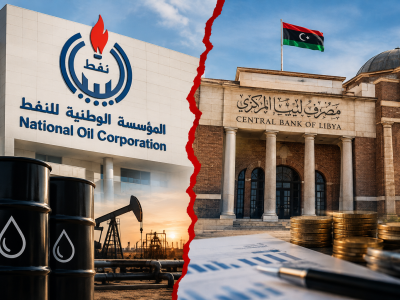
These costs matter because fuel imports directly affect the flow of Libya’s oil revenues. Under the current financial mechanism, NOC deposits oil revenues with the Libyan Foreign Bank, which deducts the value of fuel import letters of credit before transferring the remaining funds to the Central Bank of Libya.
Refining Capacity Remains a Strategic Weakness
Libya’s growing crude production makes the high fuel import bill increasingly difficult to justify from an economic perspective. NOC reported crude production of 41.7 million barrels in July, while the country has recently approached 1.5 million barrels per day in daily output.
Yet higher crude production does not automatically translate into greater domestic fuel availability. Libya needs functioning refineries, reliable infrastructure and an efficient distribution network to convert more of its crude into products that meet domestic demand.
The planned rehabilitation of major refining assets could therefore have a significant impact on the import bill. NOC has said it aims to restart the Ras Lanuf refinery within six months to one year, which could eventually increase domestic refining capacity and reduce pressure on imports. The July data also arrived as renewed attacks targeted energy infrastructure around Zawiya. The attacks damaged fuel storage facilities and disrupted operations at a critical energy hub, adding another layer of risk to Libya’s fuel supply system.
For Libya, the challenge now goes beyond producing more crude. The country must capture more value from that production at home. Reducing fuel imports will require stronger refining capacity, tighter distribution controls and better protection of energy infrastructure.
Until those weaknesses improve, Libya could continue exporting valuable crude while spending more than $1 billion in some months to bring refined fuel back into the country.