Libya’s National Oil Corporation reported strong energy income in April, underscoring the oil sector’s central role in the country’s economic recovery.
The corporation said total oil revenues collected and transferred to the sovereign account at the Libyan Foreign Bank reached $2.82 billion in April 2026. The figure marks another high-revenue month for the sector as crude production remains near multi-year highs and export flows remain relatively stable.
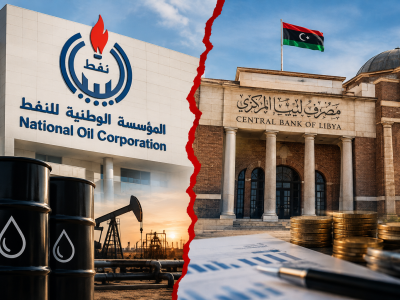
Under the current financial arrangement, the value of fuel import letters of credit processed through the Libyan Foreign Bank will be deducted from the gross amount. After those deductions, $1.91 billion will move to the Central Bank of Libya.
For Libya, the April figures matter beyond headline revenue. They show that the oil sector continues to finance the state at a time when policymakers face pressure to stabilize public spending, contain currency stress, and support infrastructure investment. Oil remains the backbone of Libya’s economy. When revenue collection improves, the government gains more room to manage fiscal obligations and sustain imports.
The latest figures also suggest that operating conditions in the sector have improved compared with previous years. Libya spent much of the past decade dealing with shutdowns, blockades, and sudden production interruptions. In contrast, recent months have brought more continuity in exports and upstream activity. That stability has helped the country capture stronger hydrocarbon income.
Oil revenues strengthen Libya’s fiscal position
NOC also said revenues from royalties and taxes on concession contracts collected on behalf of the Ministry of Oil reached around 2.86 billion Libyan dinars during April.
Those additional receipts highlight another important point. Libya’s energy sector does not only generate export cash flow. It also creates fiscal inflows through taxes and contractual obligations tied to international operators.
The April revenue release comes during a wider period of momentum for Libya’s energy sector.
In recent weeks, NOC signed a preliminary agreement with Chevron to assess Libya’s shale oil and gas potential across several sedimentary basins. The move signals renewed international interest in Libya’s hydrocarbons. It also reinforces the country’s push to expand exploration after years of underinvestment.
Reuters reported that preliminary estimates point to about 123 trillion cubic feet of gas and roughly 18 billion barrels of oil in targeted basins.
Investment momentum supports longer-term growth
That broader investment backdrop matters because revenue growth alone will not guarantee long-term energy expansion.
Libya still needs sustained capital spending across upstream facilities, export infrastructure, field maintenance, and storage systems. Without it, the country will struggle to meet its medium-term production ambitions. Officials have repeatedly pointed to a target of 1.6 million barrels per day by the end of 2026. Reaching that goal will depend on whether the current operational calm continues. It will also depend on whether foreign partners remain willing to commit technical and financial resources.
For now, April’s numbers provide a positive signal. They show that Libya continues to generate large-scale hydrocarbon income at a time when international markets remain focused on supply security. Regional producers are also trying to capture higher market share.
In practical terms, the $2.82 billion figure strengthens the state’s short-term fiscal position. It also gives policymakers a clearer revenue base as they navigate monetary pressures and economic management.
For the market, the message is equally important. Libya’s oil sector remains politically volatile, but commercially it is regaining relevance. Stable production, consistent transfers, and renewed international engagement all point in the same direction. Libya is moving back toward the center of regional energy conversations.
If the country sustains production and avoids major disruptions, April may prove more than a strong month. It may mark another step in Libya’s broader effort to convert operational stability into durable energy growth.