Ankara’s growing engagement with eastern Libya does not necessarily signal a retreat from its long standing partnership with Tripoli. It increasingly looks like an attempt to build influence across Libya’s competing centers of power.
For much of the past decade, Türkiye’s position in Libya was relatively easy to define. Ankara stood behind the authorities in Tripoli, provided decisive military support during Khalifa Haftar’s failed campaign to capture the capital, and built much of its political, security and economic presence around western Libya.
That description is becoming less adequate.
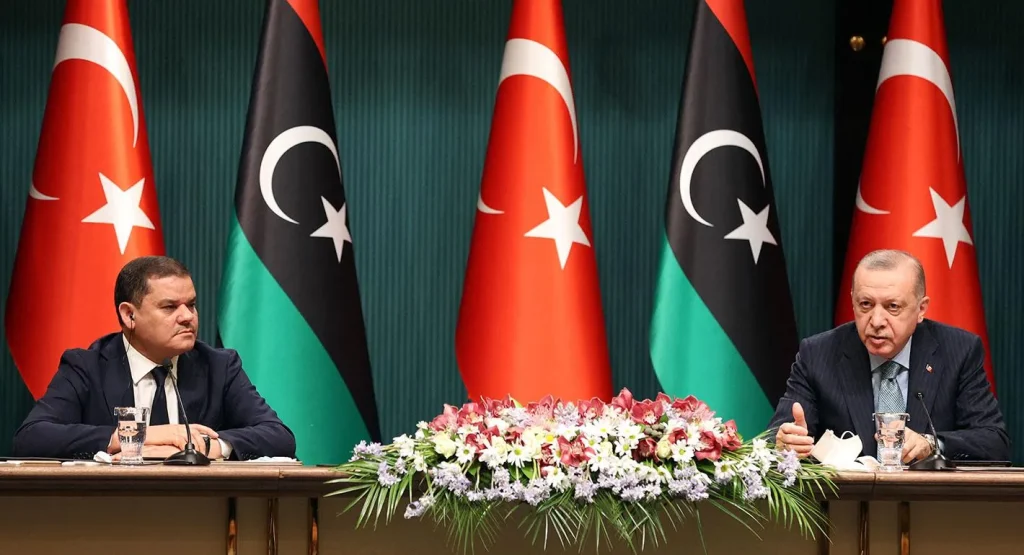
The clearest indication came during Foreign Minister Hakan Fidan’s August 11 to 12 visit to Libya. Fidan began in Tripoli, where he met Prime Minister Abdul Hamid Dbeibah, Presidential Council President Mohamed al Menfi and High Council of State President Mohamed Takala. He also visited the Turkish Armed Forces’ Libya Task Group. But he then travelled to Benghazi, meeting Khalifa Haftar, his son and deputy commander Saddam Haftar, House of Representatives Speaker Aguila Saleh and reconstruction fund chief Belqasim Haftar.
The itinerary was significant because Ankara did not substitute Benghazi for Tripoli. It visited both.
Türkiye’s recent moves are better understood not as the abandonment of its western policy, but as its gradual expansion into a more flexible Libya strategy designed to maintain access to major political and military actors. The question is how far it can widen its relationships in the east without weakening the assets it has accumulated in the west.
The shift did not begin with Fidan’s visit. Türkiye had already been rebuilding channels with eastern Libya through humanitarian assistance, commercial contacts and security dialogue. Saddam Haftar’s contacts with Ankara became particularly important. An analysis by the Middle East Council on Global Affairs notes that Turkish outreach accelerated after the 2023 Derna disaster, when Turkish relief efforts and the return of construction companies helped create practical links with authorities in the east.
From Military Ties to Wider Security Engagement
Security ties have also become more complicated than the old Türkiye versus Haftar framework suggests. In April, Reuters reported that satellite imagery showed Turkish made Bayraktar TB2 drones at an eastern Libyan airbase, although Reuters could not determine how the aircraft had been obtained or who was operating them. The development was notable because technology closely associated with Türkiye’s intervention against Haftar in 2019 and 2020 was now visible in territory controlled by his forces.
Ankara nevertheless continues to cultivate the western military establishment. On August 30, Fidan received acting Libyan army chief Salah al Din al Namroush in Ankara. This parallel engagement illustrates the core of the emerging approach: Türkiye is developing channels into Libya’s competing security structures rather than relying on one side alone.
Political diplomacy has followed the same pattern.
On September 10, Turkish intelligence chief İbrahim Kalın met Aguila Saleh and Mohamed Takala in Ankara. The encounter brought together the heads of Libya’s two rival legislative institutions and focused on political consensus, elections and institutional unification. Saleh and Takala subsequently agreed to reactivate the joint 6+6 committee dealing with electoral legislation.
That initiative overlapped with a broader UN effort to revive Libya’s stalled transition. On August 30, UNSMIL announced an agreement on the first stages of a new political roadmap, including changes to the electoral framework and a commitment to work toward presidential and parliamentary elections within 24 months. On September 15, the mission also welcomed the House of Representatives’ endorsement of that agreement.
Türkiye’s diplomatic activism therefore comes at a moment when Libya’s rival institutions are again testing whether limited procedural agreements can be converted into a broader political settlement. Ankara may see an opportunity to position itself as an external actor capable of speaking simultaneously to Tripoli, Benghazi and important security actors on both sides.
Reconstruction and Energy Open New Channels
There are also straightforward economic reasons for the outreach.
Eastern Libya contains major reconstruction opportunities and sits close to strategic oil infrastructure. Turkish companies have long viewed Libya as an important market, while Ankara’s relationship with Belqasim Haftar’s reconstruction apparatus gives the economic dimension of the eastern opening particular weight.
Energy may prove even more consequential. In February, Libya held its first major oil and gas licensing round in almost two decades. A consortium involving Türkiye’s state owned TPAO, Spain’s Repsol and Hungary’s MOL secured Offshore Area 07. For Türkiye, Libya is therefore no longer simply a geopolitical theatre or a maritime partner. It is becoming a more direct component of its upstream energy strategy.
That also increases Ankara’s exposure to Libya’s chronic instability. On September 15, Reuters reported disruptions at the Hamada, Tahara and NC5 oilfields after members of the Petroleum Facilities Guard closed a key pipeline. National Oil Corporation chairman Massoud Suleman said overall production remained near 1.4 million barrels per day, but the episode illustrated how quickly institutional or security disputes can threaten the country’s most important revenue stream.
The most sensitive element remains the Eastern Mediterranean.
Türkiye’s 2019 maritime arrangement with the Tripoli based government remains central to Ankara’s regional maritime strategy, but it has never enjoyed comparable political acceptance in eastern Libya. Greece and other regional actors have strongly challenged the agreement. That gives Ankara another reason to maintain dialogue with Aguila Saleh and the Haftar camp, although engagement should not be confused with eastern endorsement of the maritime accord. That distinction remains crucial.
The eastern side has its own reasons to engage Türkiye. Haftar’s camp gains access to a major NATO military power, a large nearby economy, reconstruction expertise and another diplomatic channel beyond its established relationships with Egypt, the UAE and Russia. For eastern Libyan actors, better relations with Ankara can broaden their external options just as Türkiye is seeking to broaden its internal Libyan ones.
This convergence does not eliminate the limits of the relationship. Türkiye still has military, political and institutional investments in western Libya that cannot simply be transferred eastward. Haftar’s forces retain relationships with other foreign powers, including Russia. Libya’s electoral process remains fragile, and agreements among senior institutions have repeatedly failed to produce durable national settlements.
What is changing, however, is the geometry of Turkish policy.
Ankara entered the previous phase of Libya’s conflict as the indispensable foreign protector of Tripoli. It now appears to be trying to preserve that influence while making itself increasingly difficult for Benghazi to ignore. If that balancing effort continues, Türkiye’s Libya policy will be defined less by exclusive alignment with one camp and more by an attempt to maintain leverage across the country’s fragmented political landscape.
That would not mean Ankara has left Tripoli behind. It would mean that Tripoli is no longer the outer limit of Türkiye’s Libya strategy.