Comments by the UK ambassador to Libya this week reflected growing international optimism that Libya can move beyond years of instability and reposition itself as a major regional energy and investment hub. Yet behind the diplomatic language lies a more important question for markets and policymakers: can Libya finally translate its energy wealth into long-term economic stability?
British Ambassador Martin Reynolds said Libya remains capable of overcoming its challenges and achieving a more stable future if political actors cooperate and maintain institutional coordination. For Libya’s economy, that issue matters far beyond politics. The country’s future growth still depends heavily on oil production, foreign investment, and the ability to restore confidence among international energy companies. The UK’s renewed engagement with Libya increasingly reflects those economic realities.
Energy Remains the Core of Libya’s Economic Recovery
Libya continues to hold Africa’s largest proven oil reserves, while its geographic position gives it direct strategic access to European energy markets. That combination has regained importance as Europe looks for diversified energy supplies amid continued geopolitical uncertainty.
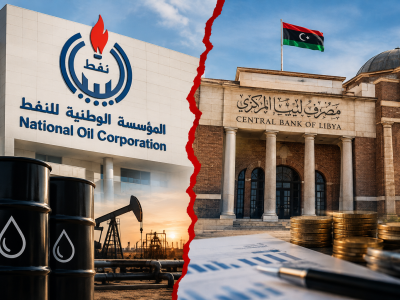
International institutions expect Libya’s economy to expand in 2026 largely because of higher oil output. The IMF projects real GDP growth of 6.7% this year, while the World Bank expects strong expansion driven by recovering hydrocarbon activity. Oil production recovery remains the central driver behind that outlook. Libya averaged around 1.3 million barrels per day in 2025 after disruptions linked to political disputes and Central Bank tensions eased. Some Libyan officials now aim to push production toward 1.6 million barrels per day by the end of 2026.
That explains why British diplomatic messaging increasingly focuses on stability, investment, and institutional cooperation rather than purely political mediation. London sees Libya not only as a security issue in North Africa, but also as a future energy and infrastructure market where British firms could expand their role. British and Libyan officials already discussed greater cooperation in oil, gas, and investment during several meetings over the past year.
The UK government’s own trade data shows growing economic ties. British exports to Libya reached £360 million in the four quarters ending in Q3 2025, marking a 30% increase year-on-year.
Foreign Investors Still Face Structural Risks
Despite the positive outlook, Libya still faces major structural obstacles that continue to limit large-scale foreign investment.
The country remains divided between rival political and military centers of power. Budget disputes, institutional fragmentation, and uncertainty around revenue distribution continue to create risks for international companies considering long-term projects. The IMF warned in April that Libya’s economic outlook still faces significant downside risks tied to oil disruptions, fiscal pressures, and political instability.
Energy infrastructure also remains vulnerable. Repeated shutdowns, maintenance problems, and security disruptions continue to affect export capacity and investor confidence. Even Europe’s growing interest in Libyan energy does not eliminate those concerns. Reuters recently reported that Libya’s gas exports to Italy declined because of infrastructure constraints, domestic demand pressures, and instability affecting the Greenstream pipeline.
That creates a contradiction at the center of Libya’s economy. Global demand for Libyan oil and gas remains strong, but the country still struggles to provide the institutional predictability that major investors require. The UK appears increasingly focused on helping Libya improve that environment. British diplomatic and trade institutions continue promoting cooperation on governance, economic transparency, and investment frameworks.
Libya’s Biggest Opportunity May Be Beyond Oil
Although hydrocarbons dominate current economic discussions, Libya’s long-term opportunity extends beyond crude exports alone.
The country sits at the center of several emerging regional trends. Europe needs nearby energy suppliers. Mediterranean shipping routes continue gaining importance. North Africa also faces rising demand for infrastructure, logistics, electricity generation, and industrial development. If Libya stabilizes enough to attract sustained investment, it could position itself as a regional transit and energy platform connecting Europe, North Africa, and the Sahel.
That possibility increasingly attracts foreign attention. British companies already show growing interest not only in upstream oil projects, but also in infrastructure, services, logistics, and technology partnerships tied to Libya’s broader reconstruction cycle.
Libyan officials have also approved new foreign and joint ventures in recent months as authorities attempt to reopen the economy to outside capital. Still, Libya’s economic future ultimately depends less on resource potential and more on governance.
The country already possesses enormous energy reserves, strategic geography, and access to major export markets. What it lacks is a stable institutional framework capable of protecting investment, unifying fiscal policy, and maintaining uninterrupted production. That remains the real test behind the UK ambassador’s optimism.
Foreign governments increasingly believe Libya still has a pathway toward economic recovery and energy expansion. However, international confidence alone will not deliver sustainable growth. Libya must prove it can maintain stability long enough for investment cycles, infrastructure development, and private sector expansion to take hold.
For now, the country stands at an important economic crossroads. Rising oil output and renewed international engagement provide momentum. But without deeper structural reform, Libya risks remaining trapped in the same cycle where energy wealth generates short-term recovery without creating durable economic transformation.