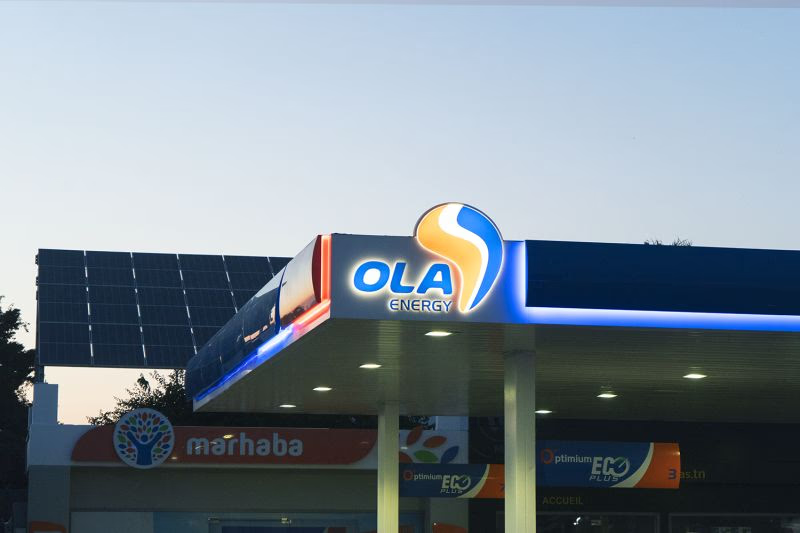
Libya’s OLA Energy has strengthened its position as one of Africa’s leading downstream fuel companies after agreeing to acquire TotalEnergies’ assets in Ethiopia. The deal marks another step in Libya’s broader effort to expand its commercial presence across the continent through strategic investments rather than relying solely on crude oil exports.
The acquisition includes around 120 fuel service stations, a fuel storage terminal with a capacity of 13,000 cubic meters and TotalEnergies’ downstream commercial operations in Ethiopia. Once completed, the transaction will make OLA Energy the country’s largest foreign fuel retailer and further expand its network across sub-Saharan Africa.
The agreement also highlights the growing role of Libyan-owned companies in African energy markets at a time when several international oil majors continue reshaping their downstream portfolios.
A Strategic Investment Beyond Libya’s Borders
OLA Energy, formerly known as Oil Libya, operates under the Libya Africa Investment Portfolio (LAIP), one of Libya’s sovereign investment institutions. The company already has operations in more than 15 African countries, supplying fuels, lubricants, aviation fuels and storage services.
The Ethiopian acquisition strengthens OLA Energy’s presence in East Africa, one of the continent’s fastest-growing regions. Ethiopia’s population exceeds 130 million people, while economic growth continues to drive higher demand for transport fuels despite foreign exchange shortages and ongoing market reforms.
For Libya, the investment represents more than a simple corporate expansion. It demonstrates how Libyan state-owned assets can generate revenues abroad while building commercial influence across African markets.
Unlike upstream oil production, downstream businesses such as fuel distribution and retail generate recurring income through daily commercial activity. This provides greater diversification for Libya’s overseas investments and reduces dependence on domestic hydrocarbon production alone.
The deal also aligns with broader efforts to improve returns from Libyan sovereign assets across Africa, many of which have remained underutilized during years of political instability.
TotalEnergies Continues Portfolio Reshaping
The transaction reflects a wider trend among international energy companies.
Over the past several years, TotalEnergies has focused investment on large upstream projects, liquefied natural gas and renewable energy while selectively exiting downstream operations in markets that offer lower returns or present operational challenges.
Industry analysts have pointed to Ethiopia’s regulated fuel pricing system, foreign currency shortages and import constraints as factors that have reduced profitability for international fuel retailers.
For OLA Energy, however, the market presents a different opportunity. As a company with deep regional experience and an established African operating model, OLA Energy can integrate the Ethiopian assets into its existing network and benefit from economies of scale across fuel procurement, logistics and distribution.
The acquisition also reinforces the company’s long-term strategy of expanding through targeted acquisitions rather than organic growth alone.
What It Means for Libya’s Economic Strategy
Although financial details have not been disclosed, the transaction carries important implications for Libya’s international economic ambitions.
Much of the country’s global energy profile revolves around crude oil exports from the National Oil Corporation. OLA Energy demonstrates that Libya also possesses internationally competitive downstream businesses capable of operating across African markets.
As governments across Africa continue investing in transport infrastructure, logistics and industrial development, demand for reliable fuel distribution networks is expected to increase over the coming decade. That creates opportunities for companies with established regional footprints.
For Libya, successful expansion by OLA Energy enhances the value of its sovereign investment portfolio while strengthening economic ties with one of Africa’s largest economies. It also supports a broader objective of diversifying national income through profitable overseas investments.
The acquisition sends a clear signal that Libyan-owned companies remain active participants in Africa’s evolving energy landscape. While international oil majors continue adjusting their global portfolios, OLA Energy has chosen to expand. That strategy could position the company, and Libya itself, to play a larger role in the continent’s downstream energy sector in the years ahead.