Libya is edging closer to restoring Western investment confidence, particularly from the United States, but that opportunity will depend on how quickly the country addresses the political, institutional and regulatory gaps that still make investors cautious.
For years, Libya was viewed mainly through conflict, migration and security, but Washington’s latest engagement suggests the country is now being framed as an economic question shaped by oil, gas, ports, trade routes and influence in North Africa.
The shift is notable because Libya still carries the weight of the 2011 Western intervention, which began during the administration of former U.S. President Barack Obama before NATO took sole command of the international military effort. Under Republican President Donald Trump, however, the current U.S. approach appears to treat Libya less as a post-2011 security file and more as a commercial and energy opening, as Washington seeks to deepen influence across Africa and keep North Africa within its strategic reach.
That approach has become clearer through the role of Massad Boulos, Washington’s senior adviser for Arab and African affairs, who is seeking to broker a power-sharing agreement between Libya’s rival eastern and western administrations, the Financial Times reported in June 2026.
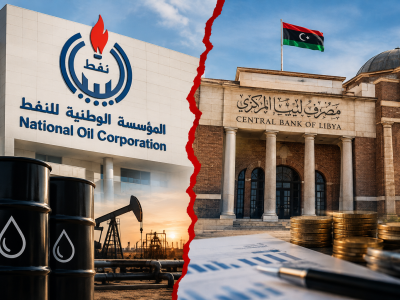
In an interview with the newspaper, Boulos said: “Our plan is to have one unified government and to unify all the institutions.” The U.S. push also aligns with how British lawmakers have described Libya’s crisis. A UK Parliament research briefing says Libya remains divided geographically and politically, with rival administrations governing the eastern and western parts of the country.
That assessment supports Washington’s argument that any serious economic opening in Libya depends first on unifying state institutions and reducing the political deadlock. Meanwhile, Libya’s economic importance remains clear, with the World Bank projecting real GDP growth of 13.3 percent in 2025 and 4.5 percent in 2026, driven mainly by stronger oil output.
The IMF also projects 6.7 percent growth in 2026, showing that hydrocarbons will remain central to the country’s recovery.
That dependence, however, remains both Libya’s opportunity and its biggest weakness, because foreign capital can bring money, technology and confidence, but it can also deepen rivalry if rival authorities continue to compete for revenue, contracts and public spending.
Russia, Energy And Western Strategy
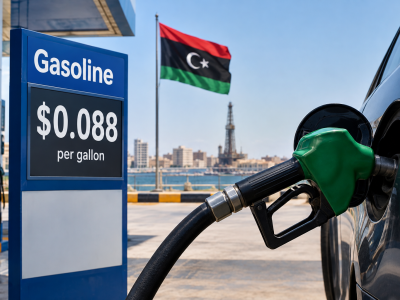
The energy picture began shifting further in 2026 as Libya reduced Russian fuel flows and turned to Western traders such as Vitol, Trafigura and TotalEnergies for gasoline and diesel.
Russian fuel exports to the country fell to about 5,000 barrels per day in 2026, down from 56,000 barrels per day in 2024 and 2025. Italy also overtook Russia as Libya’s top fuel supplier, a development that strengthened the argument that Libya’s energy relationships were shifting towards Western-linked companies and European supply chains.
That shift matters because Libya also fits into a wider Western strategy to limit Russian influence in North Africa and the Mediterranean, even if the approach is not yet as visible as Washington’s recent engagement in the Democratic Republic of Congo and Venezuela.
The Wall Street Journal reported that U.S. efforts to encourage cooperation between Libya’s rival forces are part of a wider push to reduce Russian influence in North Africa, where Libya offers oil, Mediterranean access and a strategic foothold close to Europe.
Libya’s location gives it a strong case for renewed Western engagement because it offers the U.S. a Mediterranean foothold close to Europe, access to African oil and gas, and an alternative energy route at a time when markets remain exposed to tension in the Middle East and dependence on Russia.
Oil Majors Return
More importantly, the calibre of companies returning to Libya shows why Washington is paying closer attention, especially after the country awarded exploration blocks to Chevron, Eni, QatarEnergy and Repsol in its first oil and gas licensing round since 2007.
The awards covered onshore acreage in the Sirte and Marzuq basins, as well as offshore blocks in the Mediterranean, placing some of the world’s most recognized energy companies back in a country that has long struggled to convert its resource wealth into stable national growth. The list gives Libya new commercial visibility, with Eni, QatarEnergy, Repsol, MOL, Turkey’s TPOC, Chevron and Nigeria’s Aiteo securing exploration rights across the country.
These awards came shortly after Libya signed a 25-year oil development agreement with France’s TotalEnergies and U.S.-based ConocoPhillips, a deal that Prime Minister Abdulhamid Dbeibah said involved more than $20 billion in foreign-financed investment.
The agreement, signed through Waha Oil Company, aims to raise production capacity by up to 850,000 barrels per day and could generate more than $376 billion in net revenues, according to details announced by Dbeibah.
The Venezuela Lesson
Notably, Venezuela shows how quickly U.S. capital can move when Washington opens the door to an underinvested oil sector.
The Financial Times reported that U.S. investment groups are racing to capitalise on the reopening of Venezuela’s oil industry, targeting neglected oilfields and launching new investment vehicles after President Donald Trump called for companies to invest $100 billion to help rebuild the country’s energy sector.
Although the comparison is not exact, because Venezuela’s case is tied to sanctions, oil recovery and the reopening of a restricted market, the lesson still matters for Libya.
Once Washington gives a clear policy signal and investors see a path to returns, U.S. capital can move into oilfields, refineries, ports, oilfield services and energy infrastructure.
For Libya, the test is whether it can use renewed U.S. and Western interest to settle political differences, protect national institutions and turn energy wealth into wider growth. The country has oil, gas, ports, reconstruction needs and a business class that could benefit from clearer rules, wider global engagement and a more predictable investment climate.
If Libya stabilizes its institutions, it could position itself as a Mediterranean energy and logistics hub at a time when Western governments are looking for reliable partners close to Europe, Africa and the Middle East.