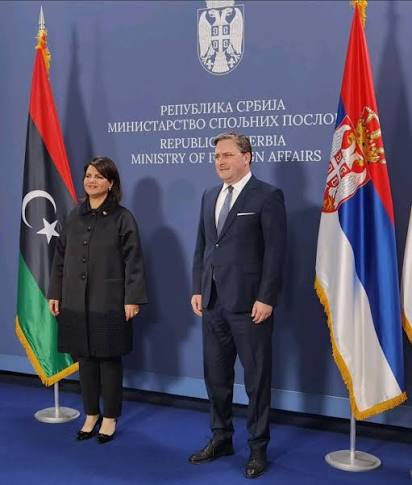
Libya and Serbia have reaffirmed their commitment to expanding economic and trade cooperation, as both sides explore new channels for investment, private sector engagement, and institutional coordination. The discussions in Tripoli focused on practical steps to strengthen bilateral trade frameworks and unlock opportunities for Serbian companies in Libya’s market.
Officials highlighted Libya’s participation in Serbia’s upcoming EXPO as a strategic platform to showcase investment opportunities and deepen commercial engagement between the two countries. The talks also addressed mechanisms to activate long-stalled cooperation structures, including the Libyan-Serbian Joint Committee and plans to establish a joint chamber of commerce.
Strengthening institutional frameworks for economic cooperation
Both sides placed strong emphasis on moving beyond political goodwill toward structured economic coordination. The proposed activation of the Libyan-Serbian Chamber of Commerce aims to create a direct bridge between business communities and reduce barriers for private sector partnerships.
Libyan officials stressed the need to facilitate entry for Serbian firms into key sectors, including construction, energy, infrastructure, and services. Serbian representatives, in turn, reiterated their interest in expanding the footprint of Serbian companies in Libya, particularly in projects tied to reconstruction and industrial development.
The discussions also reflect a broader trend in Libya’s foreign economic policy, where authorities increasingly prioritize diversified partnerships and foreign investment inflows to support reconstruction and economic stabilization efforts.
Trade expansion linked to EXPO 2027 and private sector engagement
A key element of the talks centered on Serbia’s EXPO 2027 in Belgrade, which Libya views as an opportunity to present its investment climate and attract Serbian and international partners. Both sides agreed that participation in international exhibitions can help translate diplomatic relations into tangible business outcomes.
In parallel, the two countries continue to build on earlier steps, including business forums and memoranda of understanding that laid the groundwork for structured cooperation. These initiatives aim to support long-term trade growth rather than short-term exchanges, with a focus on institutional continuity and follow-up mechanisms.
Serbia has repeatedly signaled interest in expanding cooperation in construction, healthcare, energy, and education, while Libyan officials continue to position the country as an open market for foreign companies willing to engage in development projects and commercial partnerships.
Outlook
The renewed Libya–Serbia engagement signals a gradual shift toward more structured economic diplomacy, where both countries seek to translate historical relations into measurable trade and investment flows. If implemented effectively, the planned joint chamber of commerce and institutional mechanisms could become key drivers of sustained bilateral trade growth.
For Libya, the partnership supports efforts to diversify economic relations beyond traditional regional and European partners. For Serbia, it reinforces its strategy of expanding commercial ties outside the EU framework, particularly in emerging markets with infrastructure and reconstruction needs.
The next phase will depend on how quickly both sides operationalize the announced mechanisms and convert political agreements into active business projects.