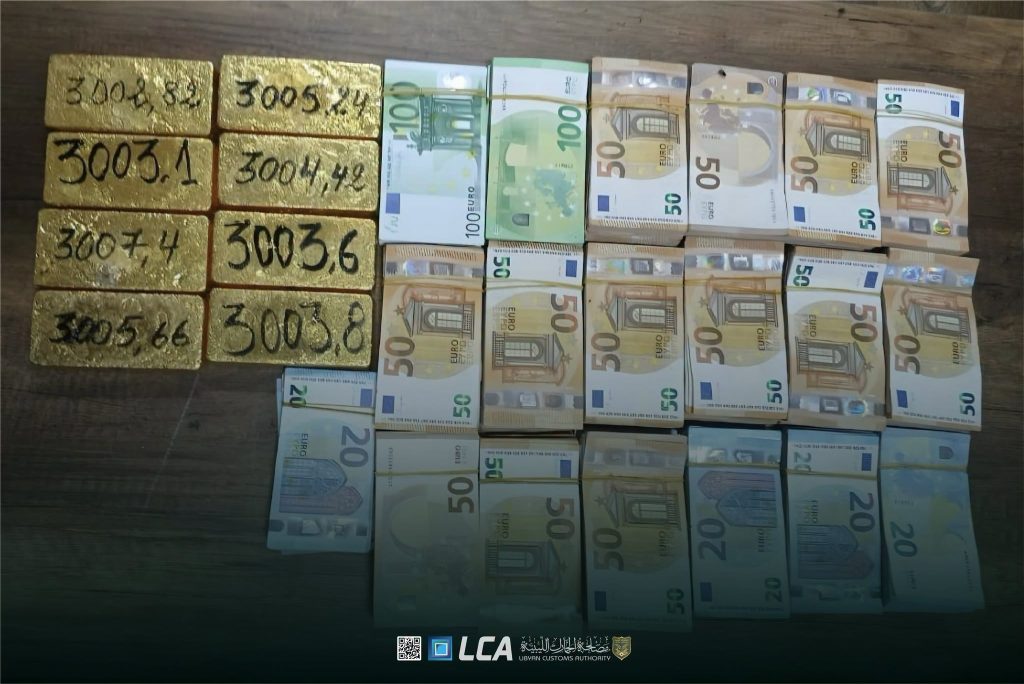
Libyan customs authorities have seized €135,800 in foreign currency and nearly 25 kilograms of gold during an inspection at the Ras Ajdir border crossing, highlighting the continued pressure on authorities to control the movement of cash and precious metals across Libya’s borders.
The Zuwara Anti Smuggling and Drugs Unit, operating under the Libyan Customs Authority, intercepted a vehicle carrying Algerian registration plates at the crossing after officers became suspicious and subjected it to a detailed inspection. Customs officials found eight gold bars and the cash concealed inside the structure of the vehicle.
The authorities have referred the case to the Al Zawiya Summary Prosecution for Corruption Crimes. The seized money and gold remain in custody while the legal investigation continues.
Border controls face growing economic importance
The seizure comes as Libya continues to strengthen controls at its land borders, where customs authorities face the challenge of monitoring large volumes of commercial and passenger traffic alongside attempts to move money and valuable commodities outside formal channels.
Ras Ajdir is one of Libya’s main land crossings and serves as an important trade and transport route between western Libya and Tunisia. Its location gives customs enforcement a direct role in monitoring cross border commerce and preventing the movement of goods and assets outside the regulated financial and customs system.
The latest seizure also illustrates the wider economic importance of customs enforcement. Large amounts of undeclared foreign currency and precious metals can move across borders without entering the formal financial system, making it harder for authorities to monitor capital flows and enforce existing regulations.
The Customs Authority said the operation forms part of efforts to strengthen oversight at border crossings and combat the smuggling of money and precious metals.
A wider challenge for Libya’s border economy
Libya has long faced difficulties controlling its extensive land borders, particularly as informal trade and smuggling networks operate alongside legitimate commercial activity. The country’s borders with Tunisia, Algeria, Egypt, Chad, Niger and Sudan connect major regional trade routes, but also create enforcement challenges for customs and security agencies.
Recent Customs Authority records show that Ras Ajdir has remained a focus of anti smuggling operations. In April, authorities reported another attempted smuggling case at the same crossing, while the latest operation involved a significant quantity of gold as well as foreign currency.
The value of the latest seizure makes the case notable beyond the individual investigation. Nearly 25 kilograms of gold represents a substantial financial asset, while the €135,800 in cash adds another layer to the case. The authorities have not publicly stated where the money or gold came from, where they were headed, or who owned them.
Those questions will now depend on the outcome of the legal investigation.
For Libya, stronger customs enforcement can help protect legitimate trade and improve oversight of cross border financial activity. But sustained results will depend not only on individual seizures, but also on consistent controls, better coordination between customs and law enforcement agencies, and stronger monitoring of trade and financial flows across the country’s borders.