Libya’s Central Bank Leadership Change: What Happens Next?
Libya has a new Central Bank governor, but the country’s economic problems will not disappear with a change of leadership. The appointment of Fawzi Abu Khazam raises a bigger question: can the Central Bank of Libya (CBL) regain the independence and authority needed to manage the country’s finances, or will it remain exposed to the political divisions that have repeatedly undermined economic stability?
On November 2, Libya’s eastern-based House of Representatives voted to accept the resignation of Naji Issa and appoint Abu Khazam as governor. Seventy-eight of the 90 lawmakers present supported the decision. Abu Khazam had already assumed the governor’s responsibilities in October, following an earlier decision by the House of Representatives.
The appointment comes after months of uncertainty surrounding Issa’s departure. He submitted his resignation in August, saying he could no longer continue in the position but declining to explain his reasons. His appointment in 2024 had followed an agreement between the House of Representatives and the High Council of State, which helped resolve an earlier dispute over control of the Central Bank.
As we examined in our previous analysis, Libya’s appointment of a new Central Bank governor has implications well beyond the bank itself. The latest decision makes those questions even more important.
A Change in Leadership Does Not Guarantee Institutional Stability
The first challenge is political legitimacy. Issa took office in 2024 after negotiations between Libya’s rival legislative institutions. That agreement helped end a crisis that had disrupted the Central Bank and contributed to an oil production shutdown.
The latest appointment has not yet demonstrated the same level of political agreement. The House of Representatives approved Abu Khazam’s appointment, but the Tripoli-based High Council of State has not publicly commented on the November 2 vote.
This distinction matters. The Central Bank cannot operate effectively if rival political institutions continue to disagree over its leadership or authority. Even if Abu Khazam maintains control of the bank’s daily operations, uncertainty over the appointment could weaken confidence in its decisions.
Libya has already experienced the economic cost of turning the Central Bank into a political battleground. During the 2024 crisis, oil production fell sharply after eastern authorities halted output amid the dispute over the bank’s leadership. The World Bank estimated that production contracted by 8.5% during the first ten months of that year, with the crisis contributing to the decline.
The lesson is clear: disputes over the Central Bank do not stay inside the banking sector. They can quickly affect oil exports, government revenue, foreign currency availability and the wider economy.
Abu Khazam must therefore secure more than administrative control. He needs an institutional arrangement that all major political actors respect. Without it, the bank could face another leadership dispute when its decisions conflict with the interests of powerful political groups.
The Real Test Is Public Spending and the Libyan Dinar
The second challenge is economic. Libya’s financial problems stem from much deeper weaknesses than the identity of its Central Bank governor.
The International Monetary Fund’s April 2026 assessment presented a difficult picture. Libya’s fiscal deficit reached around 30% of GDP in 2025, while public debt rose to 146% of GDP over the preceding two years. The IMF also warned that continued public spending could increase pressure on foreign currency reserves, the exchange rate and inflation.
These figures point to a problem that monetary policy alone cannot solve. Libya depends heavily on oil revenues, while public expenditure continues to place substantial pressure on its finances. Government wages, subsidies and other spending commitments absorb large amounts of public resources. When expenditure grows faster than sustainable revenue, demand for foreign currency increases and pressure on the dinar intensifies.
The Central Bank has a central role in managing these pressures, but it cannot control government spending on its own. The government must also accept tighter financial discipline, stronger oversight and a more credible approach to public budgeting.
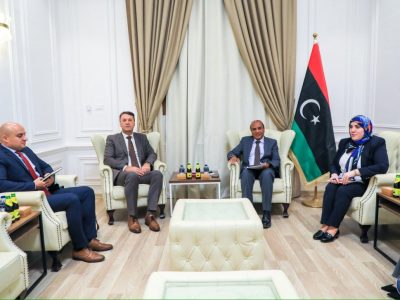
Prime Minister Abdulhamid Dbeibah’s November 2 meeting with Abu Khazam addressed several of these issues, including exchange-rate stability, coordination between monetary and fiscal policy, and controls over public spending.
These discussions are necessary, but coordination must produce measurable results. Libya needs a transparent and unified spending framework, stronger oversight of public expenditure and better reporting on how oil revenues enter and leave the state budget.
Abu Khazam must also address the pressure on the foreign exchange market. Businesses need reliable access to foreign currency to finance imports and commercial operations. Repeated exchange-rate adjustments and uncertainty over currency availability make planning more difficult and increase costs for companies and consumers.
The IMF has warned that currency adjustments cannot compensate for persistent fiscal imbalances. Without spending reform, the Central Bank will continue to face pressure regardless of who occupies the governor’s office.
Can Abu Khazam Protect the Central Bank’s Independence?
The most important question is whether Abu Khazam can establish a Central Bank that serves the wider economy rather than the interests of competing political authorities.
The institution controls the country’s foreign currency reserves, manages oil revenue flows and supervises the banking sector. Its decisions affect government finances, businesses, importers and households. This gives the governor considerable responsibility, but also exposes the position to political pressure.
Abu Khazam has already begun making institutional changes. On October 25, the Central Bank announced the reconstitution of its Monetary Policy Committee and the formation of governance, review and risk, and appointments committees. These steps offer an opportunity to strengthen internal oversight and improve decision-making.
However, new committees and administrative changes will mean little without transparency and accountability. The bank must explain its monetary decisions, provide clearer information on foreign currency allocations and strengthen oversight of public financial flows.
It must also demonstrate that it can make difficult decisions even when they conflict with political demands. That includes resisting unsustainable spending pressures and improving the management of foreign currency without repeatedly relying on measures that shift the cost onto businesses and households.
For international investors, oil companies and financial institutions, the issue is not simply whether Libya has a new governor. They need confidence that the country’s financial institutions can operate predictably and independently.
Abu Khazam has an opportunity to provide that stability, but the responsibility does not rest with him alone. Libya’s political authorities must agree to protect the Central Bank from interference and accept that public finances require consistent rules.
The appointment settles the immediate question of leadership. It does not settle the question of who controls Libya’s economic future. Unless the country addresses the political and fiscal problems behind its financial instability, another change at the top of the Central Bank will offer little more than temporary relief.