Libya’s Zawiya refinery has temporarily halted operations after a series of drone attacks targeted oil infrastructure at the complex, marking a significant escalation for one of the country’s most important fuel facilities.
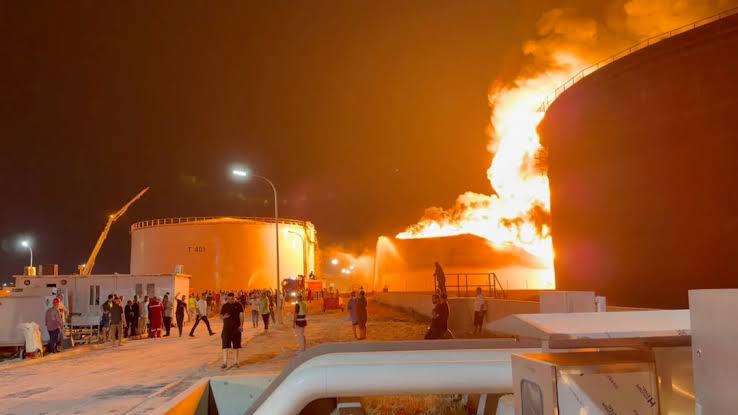
The National Oil Corporation (NOC) chief confirmed the temporary halt as firefighters continued efforts to contain a major fire at the refinery complex. The latest developments follow three drone attacks against oil-related facilities in Zawiya over the weekend and Monday.
The attacks have raised fresh concerns over Libya’s domestic fuel supply and the security of critical energy infrastructure.
Drone attacks escalate at Zawiya
The first reported strike came early Saturday, when a drone hit a tank containing untreated naphtha at the Zawiya refinery. The impact caused a leak, but refinery personnel contained it and reported no injuries or fire. A second attack targeted a water desalination facility within the wider Zawiya complex on Sunday.
On Monday, a third drone targeted an oil blending and filling plant operated by Zawiya Oil Refining Company. The drone fell near a major oil tank and a pipeline network used to supply the domestic market. The NOC initially reported no casualties or material damage from that strike.
The situation then escalated when a large gasoline storage tank operated by Brega Petroleum Marketing caught fire and collapsed. The tank held approximately 4.5 million liters of gasoline, according to the oil ministry and NOC. Adjacent tanks were emptied and cooled to prevent the fire from spreading.
No group has claimed responsibility for the attacks.
Why the shutdown matters for Libya’s fuel market
The temporary shutdown puts one of Libya’s most important domestic fuel facilities under additional pressure.
The Zawiya refinery has a processing capacity of approximately 120,000 barrels per day and sits about 40 kilometers west of Tripoli. It plays a major role in supplying Libya’s domestic market and is connected to the 300,000-bpd Sharara oilfield, one of the country’s largest crude-producing assets.
The immediate impact on fuel availability remains unclear. Brega Petroleum officials previously told Reuters that fuel and gasoline supplies had not yet been affected despite the fire, while adjacent tanks were secured to limit the risk of further damage.
However, a prolonged shutdown would increase pressure on Libya’s already costly fuel-import system. The country relies heavily on imported refined products despite its large crude reserves and significant domestic refining capacity.
For the oil market, the key issue is whether the temporary halt remains limited to refinery operations or begins to affect crude flows through the wider Zawiya complex. The NOC had already warned that continued attacks could force it to declare force majeure and completely halt operations at the refinery.
Security risk returns to Libya’s oil sector
The Zawiya attacks come only months after fighting near the refinery forced a precautionary shutdown in May. At the time, the NOC and Zawiya Refining Company evacuated personnel and suspended operations because armed clashes had reached areas around the complex. Operations resumed several days later.
The latest incidents are different because drones have directly targeted energy infrastructure rather than simply exposing the facility to surrounding fighting.
That raises a broader concern for Libya’s oil sector. The country has recently increased crude production sharply, reaching 1.44 million barrels per day in June, its highest level since 2013. Any renewed disruption to key infrastructure could complicate efforts to sustain that growth.
For now, the market will focus on three developments: how quickly the Zawiya refinery can resume operations, whether further attacks occur, and whether the NOC escalates its response by declaring force majeure.
A prolonged disruption would have implications beyond Zawiya, particularly for Libya’s domestic fuel supply and the reliability of crude and refined-product flows from western Libya.